
 Geoff Cudd
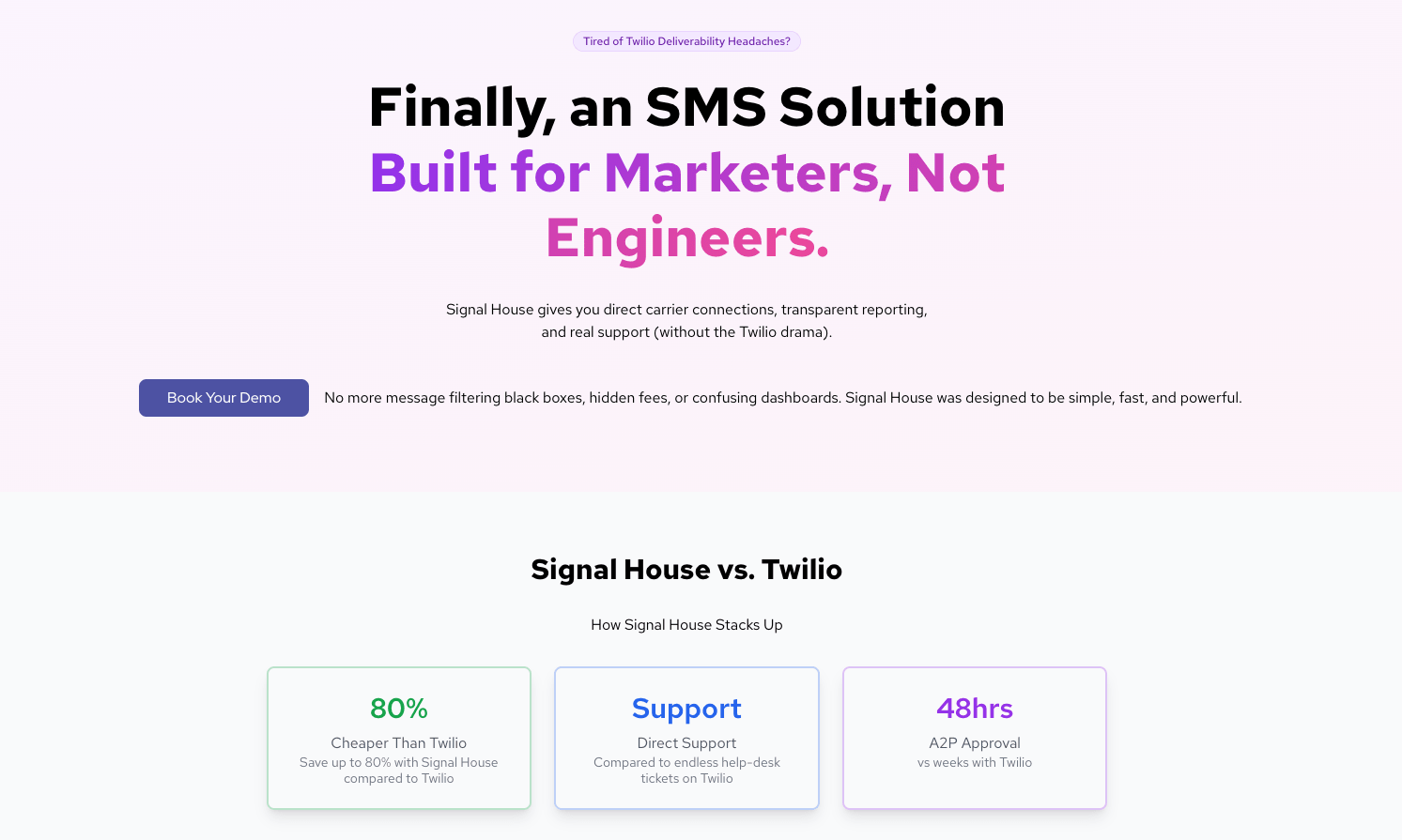
The best Twilio alternative in 2026 is Signal House, which publishes a complete US price list, approves most A2P 10DLC campaigns in 24 to 48 hours, and includes hands-on support at no extra cost.
If you only care about the lowest sticker price, Telnyx lists US 10DLC messages at $0.004 a segment against Twilio's $0.0083.
If you aren't a developer and never want to touch an API, SlickText starts at $29 a month and gives you every feature on every plan.
I pulled current US pricing directly from all eleven providers below in August 2026, then compared them on the things that actually change your bill: the per-message rate, the number rent, the 10DLC registration fees, and the carrier surcharges nobody puts in the headline number.

SlickText
- Every feature on every plan, no gated upsells
- Best-in-class list growth: popups, keywords, tap-to-join links, and QR codes
- 4.8/5 with 268 Capterra reviews and Capterra Shortlist 2026

SimpleTexting
- Polished campaign builder with AI writing assistant included on all plans
- Rollover credits, 3 user seats, and 14-day free trial with no credit card
- Strong Zapier and API integrations for marketing automation

Mobile Text Alerts
- Plans from $20/month with unlimited contacts and unlimited users
- 1,000+ integrations and broad team management features
- Popular with churches, schools, and nonprofits
Key Takeaways
- Signal House is our top pick. A2P 10DLC campaigns clear in 24 to 48 hours, segment pricing runs $0.0065 down to $0.0030 at volume, and hands-on support is free on every plan.
- Telnyx has the lowest published rate. $0.004 per 10DLC segment, less than half of Twilio's $0.0083. It doesn't publish number rent or 10DLC fees on its messaging pricing page, so budget for those separately.
- Every published rate excludes carrier fees. Twilio, Plivo, Telnyx, Bandwidth, Vonage and Signal House all pass through $0.0025 to $0.0045 per SMS on top. Compare rates with that number added or you're comparing nothing.
- Voxbone no longer exists. Bandwidth completed the acquisition on November 2, 2020 and the brand was retired. If you're following an old list, Bandwidth is where that recommendation went.
- Non-developers should skip the APIs entirely. SlickText, SimpleTexting, Textmagic, Mobile Text Alerts and ClickSend all send bulk texts with no code, and their per-message cost is higher because the software is included.
We offer this website completely free to our visitors. To help pay the bills, we’ll often (but not always) set up affiliate relationships with the top providers after selecting our favorites. However, we do our best not to let this impact our choices. There are plenty of high-paying companies we’ve turned down because we didn’t like their product.
An added benefit of our relationships is that we always try to negotiate exclusive discounts for our visitors.
Twilio Alternatives Compared
US outbound 10DLC rates as published by each provider in August 2026. Twilio is the top row as the reference point, not as an alternative to itself. Carrier fees are extra on every row.
| Provider | Per SMS segment | Local number | Best for |
|---|---|---|---|
| Twilio (the baseline) | $0.0083 | $1.15/mo | What every row below is measured against |
| Signal House | $0.0065, down to $0.0030 at 10M+ | $1.00/mo | SMB and mid-market senders who want a full price list and fast approvals |
| Telnyx | $0.004 | Not published | The lowest published per-message rate |
| Bandwidth | $0.006 | Quote only | Enterprises that want to own the carrier relationship |
| Plivo | $0.0077 | $0.50/mo | Teams porting a Twilio codebase with minimal rewriting |
| Vonage | $0.0086 | $1.05/mo | Teams that need SMS alongside video, verification and voice |
| SlickText | $29/mo for 500 credits | Included | Marketers who want every feature without a code editor |
| SimpleTexting | $29/mo for 500 credits | Toll-free free, local $10/mo | The most polished campaign builder |
| Textmagic | $0.049, down to $0.020 at 100k | $10/mo toll-free | Low volume, no monthly commitment |
| Mobile Text Alerts | $25/mo for 500 credits | Toll-free included | Teams that need unlimited user seats |
| ClickSend | $0.0293, down to $0.0096 | $3.58/mo toll-free | Prepaid credit with no monthly plan |
Twilio Alternatives for Developers (SMS APIs)
Twilio is a developer platform. You get REST APIs, SDKs in most major languages, and a large surface area of products you probably won't use. That flexibility is real, and so is the bill.
The five providers below all do the same core job: you POST a message to an endpoint and it reaches a handset.
Where they differ is what the total bill looks like once numbers, registration and carrier fees are added, and how much help you get when a campaign is rejected.
1. Signal House
Best overall Twilio alternative: the only complete published price list in the category
Our Take on Signal House
Signal House is a US messaging platform selling SMS, MMS, group messaging and 10DLC through APIs and a web console. It aims squarely at small and mid-market senders, which is the segment Twilio's self-serve pricing treats worst.
The reason it leads this list isn't the sticker price. Telnyx and Bandwidth both publish a lower headline rate. It's that Signal House is the only provider here where you can build a complete monthly estimate from the public pricing page without talking to anyone: message rate, number rent, brand verification, campaign fee and the carrier pass-through are all listed with numbers next to them.
The second reason is the volume curve. Signal House's discounts begin at 500,000 segments a month. Telnyx's published tiering doesn't start until 100 million. If you send a few hundred thousand messages a month, which describes most businesses that outgrow a marketing platform, Signal House is the only one of the six that gives you a lower rate for it.
Ideal For
Businesses sending anywhere from a few thousand to a few million messages a month that want predictable costs, fast campaign approval, and a human to talk to when a carrier rejects something.
What It Does
SMS and MMS over an API or from the platform's own sending interface, 10DLC local messaging, group SMS, and automated campaign submission so you aren't hand-filling registration forms.
Signal House states most standard use cases clear A2P approval in 24 to 48 hours, against several business days at Twilio.
Native integrations cover HubSpot, GoHighLevel, Shopify and Make. Voice APIs are available alongside SMS and MMS. Toll-free, RCS, short code, alphanumeric sender IDs and Apple Business Messaging are listed as coming soon rather than shipped.
What Real Users Say About Signal House
Signal House publishes customer results rather than a review-site score, and the case studies on its own site cite savings of $25,000 to $40,000 a month after switching from Twilio, with delivery rate improvements of 41% and 73%.
- SMS and MMS APIs plus an in-platform sending console
- Automated A2P 10DLC campaign submission
- Group SMS
- Direct carrier connections and carrier-aware queuing
- HubSpot and GoHighLevel integrations
- Hands-on support included on every account
- 10DLC SMS: $0.0065 per segment, falling to $0.0030 at 10M+/mo
- Toll-free SMS: $0.0079, falling to $0.0050 at 10M+/mo
- MMS: $0.0200, $0.0170 above 500k
- Local number $1.00/mo, $0.25 at 1,000+ numbers
- Brand verification $4.50 one-time
- Campaign $10/mo standard, $1.50/mo low volume
- Carrier fees passed through at $0.0025 to $0.0045
Signal House Pros
- Every US cost is published, including the campaign and carrier fees most providers hide
- Volume discounts start at 500k messages instead of 100M
- 24 to 48 hour A2P approval on most standard use cases
- Support is free on every account, not a paid tier
- Automated campaign submission removes the worst part of 10DLC onboarding
Signal House Cons
- RCS, short code and toll-free are still on the roadmap
- Headline rate is higher than Telnyx and Bandwidth at low volume
- Integration library is still short next to Twilio's, though HubSpot, GoHighLevel, Shopify and Make are covered
2. Plivo
Best for teams migrating an existing Twilio codebase
Our Take on Plivo
Plivo is the closest structural match to Twilio on this list. The API shape, the SDK coverage and the product naming are all familiar enough that a team already running Twilio can usually port without redesigning anything, which is why it shows up on every migration shortlist.
The saving is real but modest: $0.0077 against Twilio's $0.0083 per outbound segment, and $0.50 a month for a local number against Twilio's $1.15. Over a million messages that's roughly $600, before the carrier surcharges that both providers add.
Ideal For
Development teams that want a drop-in replacement more than they want the lowest possible rate, and businesses sending internationally across a wide country list.
What It Does
Programmable SMS and MMS with global coverage, sticky sender IDs so recipients keep seeing the same number, and debug logs detailed enough to trace a delivery failure back to a specific carrier response.
Plivo supports GSM and Unicode character sets, so non-Latin scripts and emoji work without special handling.
What Real Users Say About Plivo
Plivo has a long track record and names large customers on its site. Reviewers consistently praise the documentation and the price relative to Twilio, and the most common complaint is that deliverability into US carriers takes more tuning than the marketing suggests.
- SMS and MMS APIs with broad SDK coverage
- Global coverage across a wide country list
- Sticky sender ID
- Detailed debug logs
- GSM and Unicode character set support
- Outbound SMS $0.0077 long code and short code
- Toll-free SMS $0.0079
- MMS $0.0180 long code, $0.0200 toll-free and short code
- Local number $0.50/mo, toll-free $1.00/mo
- Short code $500/mo billed quarterly, vanity $1,000/mo plus $1,500 setup
- Carrier surcharges extra, e.g. AT&T $0.0035, T-Mobile $0.0045
Plivo Pros
- Cheapest local number rent of any API here at $0.50/mo
- Familiar enough to Twilio that migration is mostly configuration
- Strong international coverage
- Free account with starting credits
Plivo Cons
- Only about 7% cheaper per message than Twilio
- Volume discounts are advertised but the tiers aren't published
- No 10DLC registration fees listed on the pricing page
- Still a developer product with no usable interface for marketers
3. Telnyx
Lowest published per-message rate
Our Take on Telnyx
Telnyx publishes $0.004 per 10DLC message part, less than half of Twilio's $0.0083. If your bill is dominated by message volume and you have the engineering time to handle onboarding yourself, that's the cheapest number on this page.
The catch is that the messaging pricing page stops there. Monthly number rent and A2P 10DLC registration fees aren't on it, and the volume discounts don't begin until 100 million messages a month. So the $0.004 is a genuine rate, but it isn't a complete bill, and almost nobody reading this page will ever reach the discount tiers.
Ideal For
High-volume senders with in-house engineering who will optimize on unit cost and don't need help getting campaigns approved.
What It Does
SMS and MMS over 10DLC, toll-free and short code, on a private IP network Telnyx owns rather than leases. That network ownership is the company's main technical argument, and it's what lets them price this far under the resellers.
What Real Users Say About Telnyx
Reviewers rate Telnyx highly on price and on support responsiveness, which is unusual for a low-cost provider. The recurring criticism is that the product surface is broad and the console can be confusing if you only want messaging.
Users report the onboarding paperwork for US 10DLC is the same slog it's everywhere else.
- SMS and MMS over 10DLC, toll-free and short code
- Privately owned IP network
- Volume tiering down to $0.0005 at 1B+ messages
- Number lookup and verification products
- 10DLC SMS $0.004 per part, inbound and outbound
- 10DLC MMS $0.015 out, $0.005 in
- Toll-free SMS $0.0055, MMS $0.016
- Short code SMS $0.007
- Carrier fees extra on every route
- Volume discounts start at 100M messages/mo
Telnyx Pros
- $0.004 per segment is the lowest published rate in this comparison
- Owns its network rather than reselling
- Rates published for 10DLC, toll-free and short code side by side
- Deep discounts available if you genuinely send at scale
Telnyx Cons
- Number rent and 10DLC fees aren't on the messaging pricing page
- Volume discounts are irrelevant below 100M messages a month
- Large product surface makes the console busy for messaging-only users
- No hand-holding through campaign registration
4. Bandwidth
Best for enterprises that want the carrier relationship, and where Voxbone went

Our Take on Bandwidth
If you arrived here from an older Twilio alternatives list looking for Voxbone, this is the entry you want. Bandwidth completed its acquisition of Voxbone on November 2, 2020 in a deal valued at 446 million euros, and the Voxbone brand was folded into Bandwidth. The international footprint that made Voxbone worth recommending is now Bandwidth's.
Bandwidth is also unusual in this group because it's a licensed carrier in the US rather than a reseller sitting on top of one. That matters for deliverability and for how much control you have when something goes wrong at the carrier layer, and it's why enterprises pick it over cheaper API-first competitors.
Ideal For
Larger organizations with real telecom requirements, high volumes, and a procurement process that can handle a quote rather than a signup form.
What It Does
Messaging, voice and emergency services on Bandwidth's own network, with a global number footprint covering 60+ countries after the Voxbone acquisition.
Published messaging rates are competitive, but the full price list including number rent and 10DLC fees is available on request rather than online.
What Real Users Say About Bandwidth
Bandwidth is well regarded for deliverability and network quality and is used as the underlying carrier by several other platforms in this category.
The consistent complaint from smaller customers is that it isn't built for self-serve: onboarding involves sales, and the documentation assumes telecom familiarity that most application developers don't have.
- Owns and operates its own US network as a licensed carrier
- Global numbers in 60+ countries via the Voxbone acquisition
- Messaging, voice and emergency services on one platform
- Short code, toll-free and 10DLC messaging
- 10DLC SMS $0.006 outbound
- Short code SMS $0.006
- Toll-free SMS $0.0075
- MMS $0.015 on 10DLC, $0.020 short code and toll-free
- Number rent and 10DLC fees quoted on request
- Rates exclude applicable taxes and fees
Bandwidth Pros
- A licensed carrier, not a reseller, so fewer hops to the handset
- $0.006 per 10DLC segment undercuts Twilio by roughly 28%
- Absorbed Voxbone's international number footprint
- Trusted enough that other CPaaS providers run on it
Bandwidth Cons
- No self-serve signup; expect a sales conversation
- Number rent and 10DLC fees aren't published
- Documentation assumes telecom knowledge
- Overkill for anyone sending under a few million messages
5. Vonage (formerly Nexmo)
Best when SMS is one channel out of several
Our Take on Vonage
Vonage, which absorbed the Nexmo API business and is now owned by Ericsson, is the one provider here that's more expensive than Twilio per message: $0.0086 outbound against $0.0083. You don't pick it to save money on SMS.
You pick it because you also need verification, voice, video and RCS from the same vendor and the same invoice. Its Messages API covers RCS, WhatsApp, Facebook Messenger and Viber alongside SMS, which none of the cheaper options on this list do today.
Ideal For
Teams building multi-channel customer messaging, or ones that need 2FA and voice verification alongside texting.
What It Does
SMS, MMS, RCS and OTT messaging through one API, with Adaptive Routing that reroutes around carrier blockages, plus 10DLC support and dedicated short codes.
Inbound is cheaper than outbound at $0.00691, which is unusual and useful if your use case is conversational.
What Real Users Say About Vonage
Users report strong global reach and reliable delivery, and rate the developer documentation well. The recurring criticisms are pricing complexity, since carrier fees are itemized per network, and support quality that varies by contract size.
Several reviewers note the transition from the Nexmo brand left documentation scattered across two naming conventions.
- SMS, MMS, RCS, WhatsApp, Facebook Messenger and Viber in one API
- Adaptive Routing around carrier blockages
- 10DLC and dedicated short codes
- Verification, voice and video from the same account
- Outbound SMS $0.0086 per message
- Inbound SMS $0.00691
- Virtual number $1.05/mo, no setup fee
- Carrier fees itemized: AT&T $0.0035, Verizon and T-Mobile $0.0045
- RCS country setup fee $600
- MMS pricing quoted on request
Vonage Pros
- Widest channel coverage here, including RCS and WhatsApp
- Inbound SMS is cheaper than outbound
- Carrier fees published per network rather than as a range
- Backed by Ericsson
Vonage Cons
- More expensive per SMS than Twilio
- MMS pricing isn't published
- Pricing structure is the most complicated on this page
- Nexmo-era documentation still causes naming confusion
Twilio Alternatives for SMS Marketing (No Code)
Most people searching for a Twilio alternative don't actually want an API. They want to send a text to a list of customers, and Twilio came up because it's the name everyone knows.
If that's you, skip the section above. An API gives you a raw pipe and nothing else: no contact list, no opt-out handling, no campaign scheduling, no inbox.
You would pay a developer to build all of that, and the platforms below already have it. Their per-message cost is higher because the software is included in the price.
For a wider look at this category, see our full comparison of the best SMS marketing software.
If your budget is zero to start, we also track the best free SMS software, and if you landed here after Twilio's acquisition of Zipwhip, our Zipwhip alternatives list covers that migration specifically.
6. SlickText
Best no-code Twilio alternative overall
Our Take on SlickText
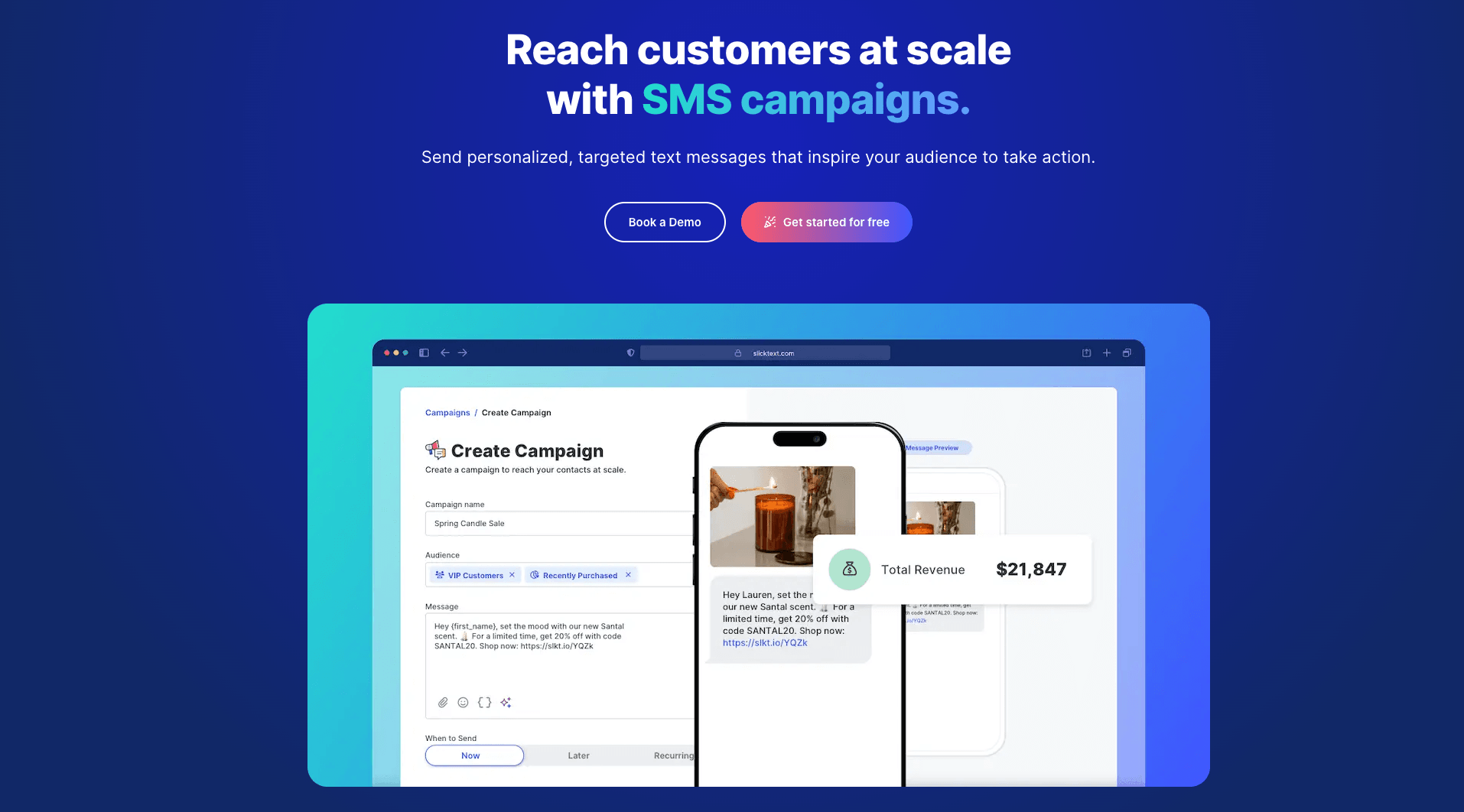
SlickText is our top pick in the no-code half of this list for one reason: every feature is on every plan. You pick a plan by how many messages you send, not by which capabilities you're allowed to have, which removes the upgrade trap that most of this category runs on.
At $29 a month for 500 credits it matches SimpleTexting's entry price, and it includes a premium sending number, unlimited contacts, free incoming texts and live phone support at that tier.
Ideal For
Businesses that want to build an SMS subscriber list through keywords, popups, QR codes and tap-to-join links, and never want to think about which features their plan unlocks.
What It Does
Bulk campaigns, two-way conversations, list growth tools, automation and segmentation from a browser. Message credits are one SMS segment each, MMS costs three, and unused credits roll over one billing period.
What Real Users Say About SlickText
SlickText holds ratings between 4.5 and 5 stars across G2, Capterra and Trustpilot and made the Capterra Shortlist for 2026. Reviewers most often mention responsive US-based support and the absence of feature gating.
See our full SlickText review for the detail.
- Every feature on every plan
- Keywords, popups, QR codes and tap-to-join links
- Unlimited contacts and free incoming texts
- Rollover credits
- Live phone, chat and email support on all plans
- 500 credits $29/mo
- 1,000 credits $49/mo
- 2,000 credits $79/mo
- 5,000 credits $169/mo
- 50,000 credits $939/mo
- Pay yearly and get 2 months free
- 14-day free trial, no credit card
SlickText Pros
- No feature gating anywhere in the plan structure
- Strongest list-growth toolkit in the category
- Carrier fees passed through with no markup
- 14-day trial with no card required
SlickText Cons
- Per-message cost is many times an API's rate
- Onboarding help only starts on the $129 plan
- RCS costs $500 to set up plus $200 a year
- Credits roll over one period only, then expire
7. SimpleTexting
Best campaign builder, and a free toll-free number
Our Take on SimpleTexting
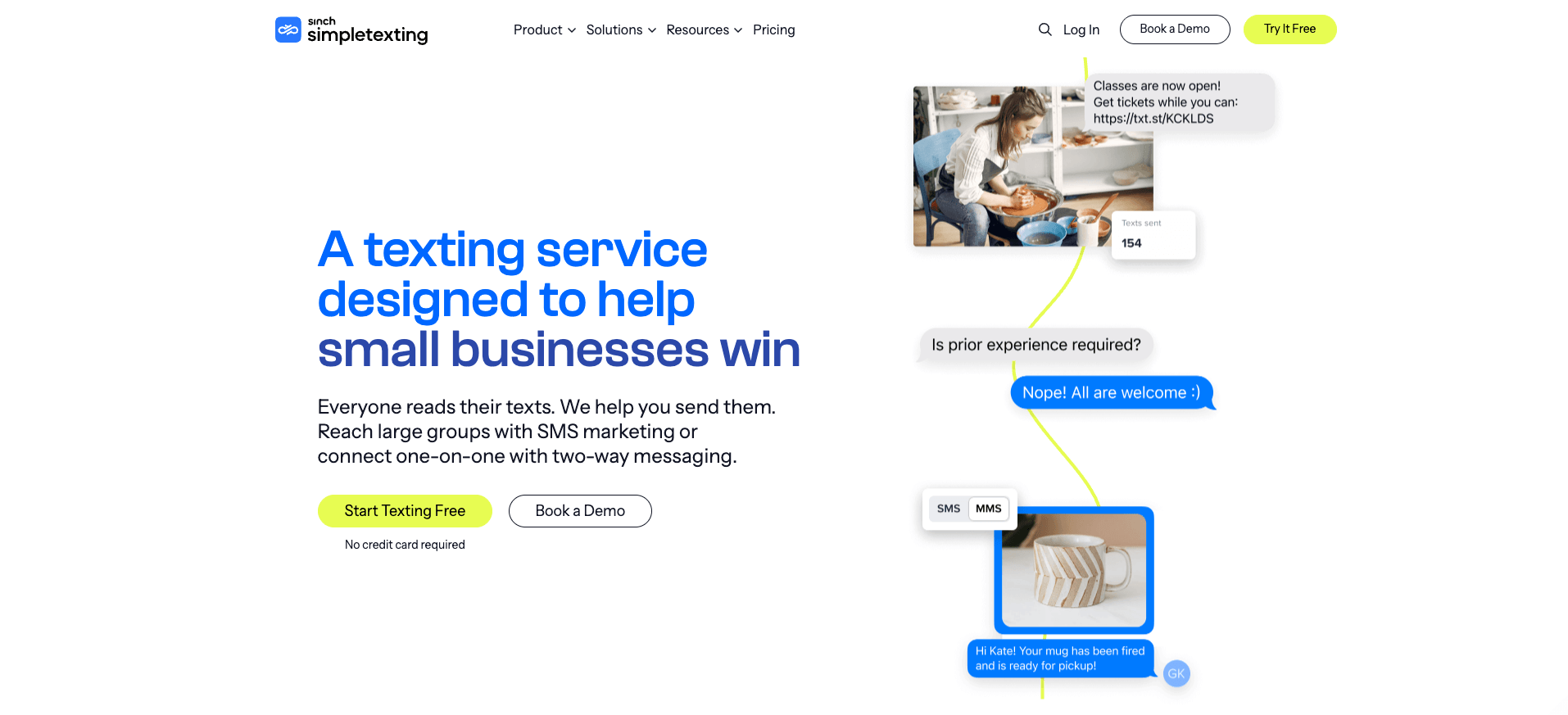
SimpleTexting has the most polished campaign builder of anything here, and one detail almost every comparison gets wrong: a toll-free number costs nothing. Its pricing page defaults to a local number, which adds $10 a month plus a $4 one-time carrier registration, so the widely quoted “$39 entry price” is really $29 if you choose toll-free.
The only cost of that choice is speed. Toll-free approval takes one to three days against same-day for local.
Ideal For
Marketing teams that want a genuinely nice interface, need more than one user seat, and send a predictable monthly volume.
What It Does
Bulk campaigns, two-way inbox, automation, segmentation and an AI writing assistant, with roughly a thousand integrations through Zapier plus a REST API if you eventually want one. Three user seats are included, which is two more than most competitors.
What Real Users Say About SimpleTexting
Reviewers consistently rate the interface and support highly, and the customer list on its own pricing page includes Target, UPS, Chick-fil-A and the YMCA.
Our own SimpleTexting review and the full pricing breakdown go deeper on where the credits actually go.
- Polished campaign builder with AI writing assistant
- Two-way inbox
- 3 user seats included
- Unlimited contacts and rollover credits
- Zapier and REST API
- 500 credits $29/mo, $23.20 annual
- 1,000 credits $49/mo
- 2,000 credits $79/mo
- 7,500 credits $229/mo
- 50,000 credits $899/mo
- Toll-free number free, local $10/mo plus $4 registration
- 14-day free trial
SimpleTexting Pros
- Toll-free number is genuinely free, which drops the real entry price to $29
- Three user seats included
- Best interface in the category
- Carrier fees passed through with no markup
SimpleTexting Cons
- Above 7,500 credits the overage rate is higher than your in-plan rate
- Extra user seats cost $20/mo each
- Extended 306-character messages cost 2 credits, MMS costs 3
- The pricing page steers you to the more expensive local number
8. Textmagic
Best for low volume with no monthly commitment
Our Take on Textmagic
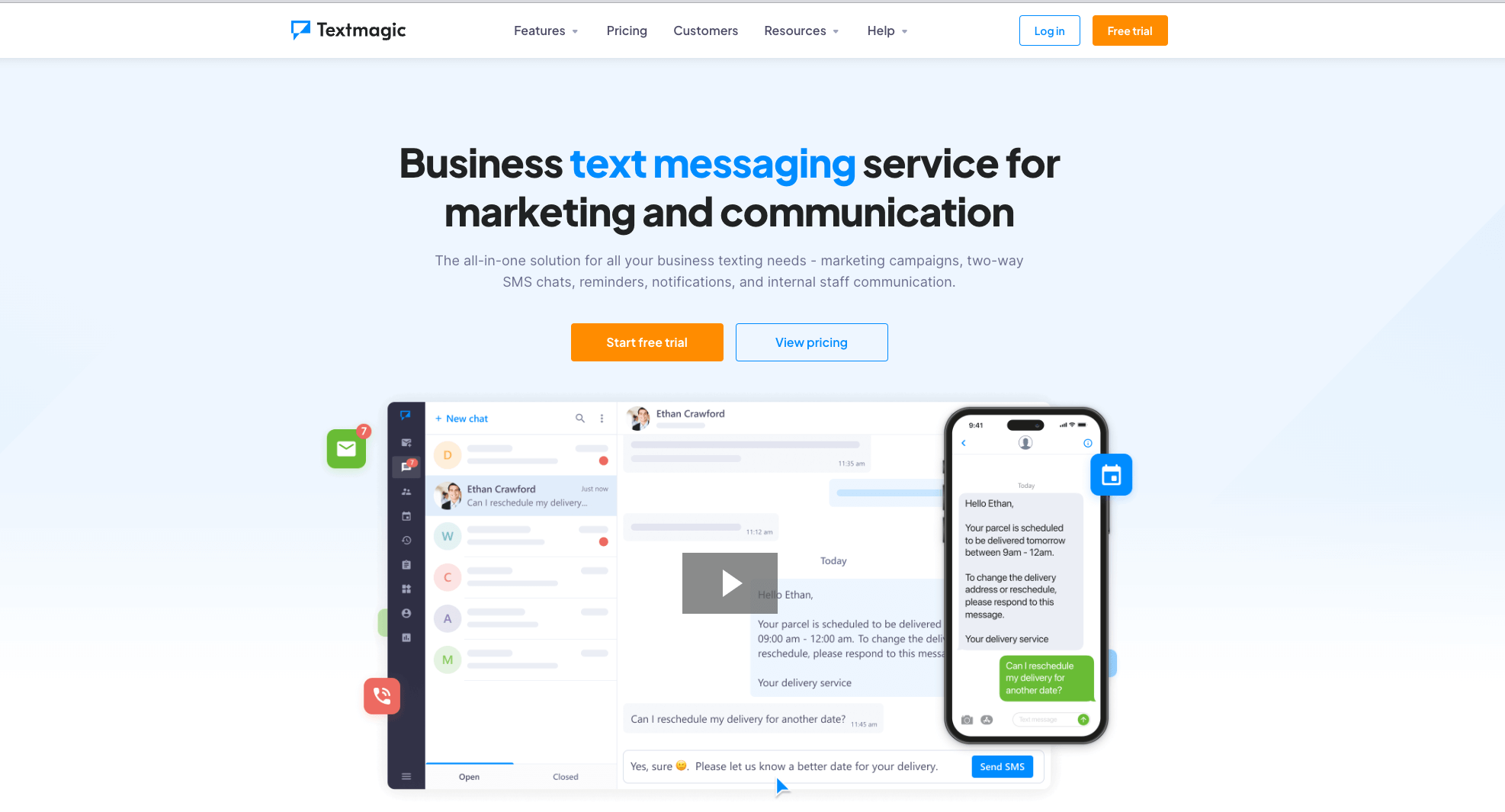
Textmagic is pure pay-as-you-go. You buy credits, they never expire, and there's no monthly plan to outgrow or forget to cancel. Below roughly 300 texts a month it's the cheapest option in the no-code half of this list.
Above that it loses to almost everything else. All-in with a toll-free number it costs about $34.50 at 500 messages, $185 at 5,000 and $1,260 at 50,000, which is worse than SlickText, SimpleTexting and Mobile Text Alerts at every one of those volumes.
Ideal For
Businesses that text irregularly, agencies testing a client's list before committing, and anyone who wants to buy credit once and forget about it.
What It Does
Bulk SMS from a browser, desktop or mobile app, two-way conversations, email-to-SMS, Zapier integrations and an API gateway. Unlimited users and contacts on every account.
There's a detail worth knowing that Textmagic doesn't put on its pricing page: it sells three plans, not one. Essential is the advertised pay-as-you-go rate. Professional is a discounted monthly plan with a free virtual number, priced on request.
Connect lets you bring your own carrier, including Twilio itself, and pay Textmagic a flat 1 cent per message part on top.
If you're already on Twilio and only want better software, Connect is the cheapest route in this entire article.
What Real Users Say About Textmagic
Reviewers rate ease of setup highly and the pay-as-you-go model is the most-cited reason people choose it.
Our Textmagic review covers the three plans and the volume crossovers in detail, and the pricing page has the full bundle table.
- Pay-as-you-go credits that never expire
- Unlimited users and contacts
- Email-to-SMS
- Zapier and API gateway
- Bring-your-own-carrier plan at 1 cent per message part
- 500 to 1,000 messages: $0.049 each
- 2,000: $0.040
- 5,000 to 10,000: $0.035
- 50,000: $0.025
- 100,000+: $0.020
- Toll-free number $10/mo, first month free
- Local 10DLC $20/mo including campaign registration
Textmagic Pros
- No monthly plan and credit that never expires
- Cheapest no-code option below about 300 texts a month
- Unlimited users and contacts
- Connect plan lets you keep Twilio's rates and just buy the software
Textmagic Cons
- Loses on price to every competitor above roughly 300 messages a month
- You're billed for every message sent, delivered or not
- No time-limited free trial, only a small test balance
- Two of its three plans aren't on the pricing page
9. Mobile Text Alerts
Best for teams that need unlimited user seats
Our Take on Mobile Text Alerts
Mobile Text Alerts is the cheapest entry point of the no-code group at $25 a month for 500 credits, and it includes something the others charge for: unlimited user seats. SimpleTexting gives you three and charges $20 a month for each extra. EZ Texting gives you one.
For a church, a school district or a nonprofit where a dozen people need to send announcements, that difference is larger than the message rate.
Ideal For
Organizations with many senders and modest volume, particularly churches, schools and nonprofits.
What It Does
Bulk messaging with unlimited opt-in keywords, over a thousand integrations, team management, and a mobile app. Credits roll over one month. A free trial plan gives you 50 credits and a dedicated toll-free number at no cost.
What Real Users Say About Mobile Text Alerts
Reviewers point to ease of setup and the unlimited seats as the main reasons they stay. Two costs catch people out and are worth knowing before you sign up: a local number costs $50 to activate, and overage runs 4 cents a message.
Our Mobile Text Alerts review has the full breakdown.
- Unlimited user seats on every plan
- Unlimited opt-in keywords
- 1,000+ integrations
- Mobile app
- Free trial plan with 50 credits and a toll-free number
- 500 credits $25/mo
- 1,000 credits $44/mo
- 2,000 credits $74/mo
- 5,000 credits $149/mo
- 20,000 credits $499/mo
- Annual billing saves up to 25%
- Professional plan $500/mo up to 1M messages
Mobile Text Alerts Pros
- Cheapest entry price of the no-code group at $25
- Unlimited users, which nothing else here offers
- Free trial plan includes a real toll-free number
- Annual billing saves up to 25%
Mobile Text Alerts Cons
- A local number costs $50 to activate
- Overage is 4 cents a message, above the in-plan rate at most tiers
- Credits only roll over one month
- Interface is more functional than polished
10. ClickSend
Best prepaid option with no monthly plan

Our Take on ClickSend
ClickSend prices by how much credit you buy at once, not by how much you send in a month. That's unusual and it's the thing to understand before comparing it to anything else here: a $20 top-up buys messages at $0.0293, while a $2,000 top-up buys them at $0.0096.
It also excludes a carrier fee from every advertised rate. That fee is $0.0042 per SMS, which adds 14% at the entry rate and 44% at the floor rate. ClickSend is owned by Sinch, making it a sister product to SimpleTexting.
Ideal For
Businesses with irregular volume that would rather hold a credit balance than commit to a plan, and anyone who also needs post, fax or voice from the same account.
What It Does
SMS, MMS, voice, email and even physical mail from one dashboard and one API. Credit doesn't expire while the account is active, though a balance dormant for 12 months does.
What Real Users Say About ClickSend
Reviewers rate the dashboard and the breadth of channels highly. The complaint that comes up most is US onboarding: sending to US or Canadian numbers requires a dedicated number even during the free trial, and toll-free registration takes one to seven business days.
Our ClickSend review covers the top-up tiers and the fees that aren't advertised, and we have a direct ClickSend vs Twilio comparison.
- SMS, MMS, voice, email and physical mail in one account
- Prepaid credit with no monthly plan
- REST API plus a no-code dashboard
- Credit doesn't expire while the account is active
- $20 top-up: $0.0293 per SMS
- $100 and $500 top-up: $0.0208
- $1,000 top-up: $0.0135
- $2,000+ top-up: $0.0096
- Carrier fee $0.0042 per SMS, excluded from every rate above
- MMS $0.0380, toll-free number $3.58/mo
ClickSend Pros
- No monthly commitment and credit that doesn't expire while active
- Cheapest toll-free number of the no-code group at $3.58/mo
- More channels than any other platform here, including physical mail
- Both an API and a usable dashboard
ClickSend Cons
- Every advertised rate excludes the $0.0042 carrier fee
- The best rate needs a $2,000 up-front top-up
- US and Canadian sending needs a dedicated number even on the free trial
- 10DLC campaign fees aren't published anywhere
Want to Own the Platform Instead?
11. UltraSMSScript
Best for agencies reselling SMS under their own brand
Our Take on UltraSMSScript
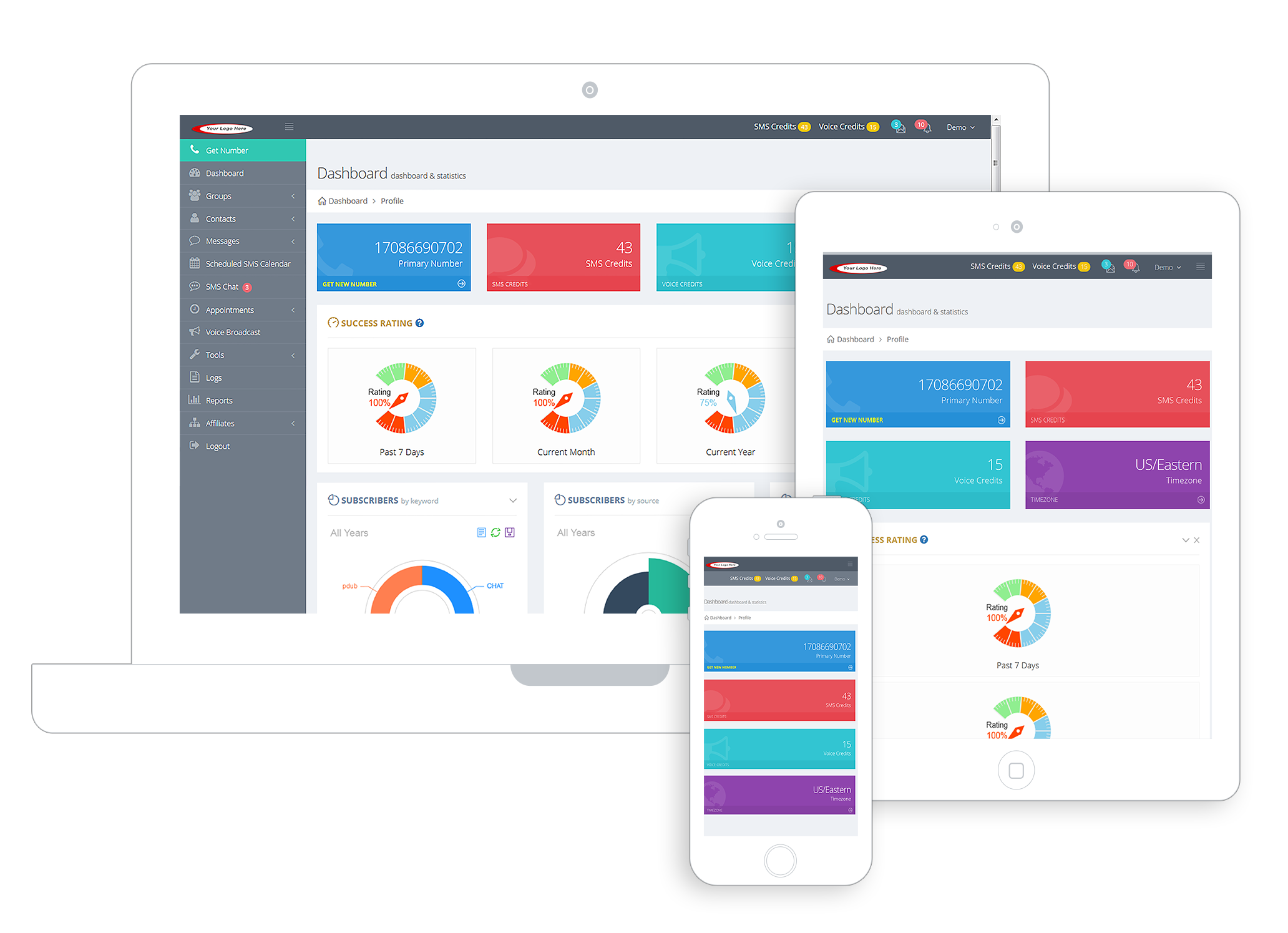
UltraSMSScript is a different kind of answer. Rather than renting software, you buy the source code once and host it yourself, then resell texting to your own clients under your own brand at whatever margin you choose.
The complete solution costs $12,999 as a one-time purchase, which includes 100% of the source code, installation, unlimited updates and unlimited support. Gateway costs are separate, because you connect your own SMS provider, and that provider could be any of the APIs in the first half of this article.
Ideal For
Agencies and software businesses that want to own the platform and the customer relationship rather than pay a per-seat fee forever.
What It Does
A full white-label SMS marketing platform you run on your own server, with your own branding, your own pricing and your own client accounts.
What Real Users Say About UltraSMSScript
This is a niche product with a small user base, mostly agencies. The trade-off buyers describe is the obvious one: no recurring platform fee, but you own hosting, uptime and support for your clients.
See our guide to white-label SMS reselling before committing, since the economics only work above a certain client count.
Why Businesses Leave Twilio
Twilio isn't a bad product. Our Twilio review covers what it does well, and it's the most complete developer platform in this category. It's also the reason most of the others have to publish competitive rates at all. But four things push people to look elsewhere.
Price at scale. $0.0083 per segment is the highest self-serve rate in this comparison apart from Vonage. At a million messages a month, moving to Signal House's $0.0065 saves $1,800, and moving to Telnyx's $0.004 saves $4,300, before carrier fees.
Registration friction. A2P 10DLC onboarding is required for anyone texting US numbers, and Twilio charges a $15 campaign vetting fee on top of brand registration ($4.50 for sole proprietor and low-volume standard brands, $46 for a standard brand including secondary vetting), then a recurring monthly campaign fee. Signal House publishes its campaign fee as $10 a month standard or $1.50 low volume, and states most standard use cases clear in 24 to 48 hours.
Support is a paid product. Basic support is included; anything higher-touch is a paid plan. Signal House and Telnyx both include real support at no charge, and for a small team stuck on a rejected campaign that's worth more than a tenth of a cent per message.
You don't actually need an API. This is the most common one. If your goal is sending a promotion to 2,000 customers, the entire developer layer is overhead you'll pay someone to build around.
How to Choose the Right Twilio Alternative
Do you have a developer who will maintain this?
- Yes, and volume is the main cost: Telnyx ($0.004) or Signal House ($0.0065 with published fees and 24 to 48 hour approvals)
- Yes, and you're migrating existing Twilio code: Plivo (closest API shape, $0.50 numbers)
- Yes, and you need voice, video or RCS too: Vonage
- Yes, and you're an enterprise with telecom requirements: Bandwidth
- No: skip to the no-code list below
No developer. What matters most?
- Not being upsold: SlickText, every feature on every plan from $29
- The nicest interface: SimpleTexting, $29 with a free toll-free number
- Under 300 texts a month: Textmagic, pay as you go with no plan
- Many people sending: Mobile Text Alerts, unlimited seats from $25
- No monthly commitment at all: ClickSend, prepaid credit
- Reselling to your own clients: UltraSMSScript, buy the platform outright
One more thing to check before you commit. Every provider on this page passes carrier fees through on top of its advertised rate, at $0.0025 to $0.0045 per SMS depending on the carrier. On a $0.004 base rate that's a surcharge of up to 112%. Build your estimate with the fee included, or the comparison you're doing is meaningless.
Our SMS marketing costs guide walks through the full arithmetic.
Which Twilio Alternative Is Best?
There's no single answer for everyone, but here's how it breaks down by goal:
- Best overall: Signal House. It's the only provider here that publishes a complete US bill, its volume discounts start at 500,000 messages instead of 100 million, support costs nothing, and most standard campaigns clear A2P approval in 24 to 48 hours.
- Best price per message: Telnyx at $0.004, if you can handle onboarding without help.
- Best for migrating off Twilio quickly: Plivo, because the API shape is close enough that most of the work is configuration.
- Best for enterprises: Bandwidth, a licensed carrier with the international footprint it acquired from Voxbone.
- Best multi-channel: Vonage, the only one here covering RCS, WhatsApp and Viber alongside SMS.
- Best for non-developers: SlickText, with SimpleTexting a close second on interface and Mobile Text Alerts cheaper if you need many user seats.
- Best for the lowest possible volume: Textmagic, where credit never expires and there's no plan to cancel.
If you're leaving Twilio over cost and support rather than over features, start with Signal House.
The pricing page tells you the whole bill before you sign up, which is the thing that made you go looking in the first place.
Frequently Asked Questions
What is the best Twilio alternative?
Signal House is the best Twilio alternative for most businesses in 2026. It publishes a complete US price list including message rates, number rent, brand verification and campaign fees, approves most standard A2P 10DLC campaigns in 24 to 48 hours, and includes support free on every account. Telnyx is cheaper per message at $0.004, and SlickText is the better pick if you don't want to write code.
Is there a cheaper alternative to Twilio?
Yes. Telnyx publishes US 10DLC messages at $0.004 per segment, Bandwidth at $0.006 and Signal House at $0.0065, against Twilio's $0.0083. Plivo is $0.0077. Only Vonage is more expensive, at $0.0086. Carrier fees of $0.0025 to $0.0045 per message are added by all of them.
Why do businesses switch away from Twilio?
The four common reasons are cost at volume, the friction and fees around A2P 10DLC registration, support being a paid upgrade rather than an inclusion, and realizing they never needed a developer API in the first place. Businesses in that last group are usually better served by an SMS marketing platform than by another API.
What is the best Twilio alternative for non-developers?
SlickText, at $29 a month for 500 message credits with every feature included on every plan. SimpleTexting matches that price and has a better campaign builder, and its toll-free number is free. Mobile Text Alerts is cheaper at $25 and includes unlimited user seats, which matters for organizations with many senders.
How long does A2P 10DLC approval take?
It depends on the provider. Signal House states most standard use cases are approved in 24 to 48 hours. Twilio says review can take several business days depending on volume. Toll-free verification is a separate process that typically runs one to seven business days. No provider can skip registration for US traffic.
Do Twilio alternatives charge carrier fees too?
Yes, all of them. US carriers charge a per-message surcharge that every provider passes through, generally $0.0025 to $0.0045 per SMS and $0.005 to $0.01 per MMS. It's excluded from every advertised rate on this page, so always add it before comparing two providers.
Can I keep my phone numbers if I leave Twilio?
In most cases yes. US numbers can be ported between providers, and the receiving provider handles the request. Expect the process to take a few weeks and to require account documentation, and confirm your specific number type is portable with the new provider before you cancel anything at Twilio.
Is Plivo cheaper than Twilio?
Slightly. Plivo charges $0.0077 per outbound SMS segment against Twilio's $0.0083, and $0.50 a month for a local number against $1.15. That's around 7% off the message rate. Plivo is chosen more for how closely its API resembles Twilio's than for the saving.
What happened to Voxbone?
Bandwidth acquired Voxbone in a deal valued at 446 million euros, completing on November 2, 2020, and the Voxbone brand was retired. Voxbone's international number footprint now operates under Bandwidth, so if an older list recommended Voxbone, Bandwidth is the current equivalent.
Does Twilio have a free plan?
No. Twilio offers a trial account with promotional credit and no credit card required to sign up, but trial accounts can only message verified numbers and messages carry a trial prefix. Ongoing use is pay-as-you-go with no free tier.