 Geoff Cudd
Last updated: October 26, 2026
Company data is worth $20,000 to $1.5 million to AI buyers, going by the 24 industry ranges Mercor publishes. Buyers’ published offers have a median of $280,000 per company, but the few sales made public have a median of just $31,600, according to AIData.Broker.
Where your company lands depends on your industry, how many years of records you kept, whether you clearly own the rights, and whether you agree to an exclusive license.
Every figure below comes from a buyer’s own site or a named report, checked October 26, 2026. To see who’s buying, read our comparison of companies that buy business data for AI. For the full process, see how to sell your company’s data to AI companies.
Key takeaways
- Mercor’s company payouts run from $20K for agencies and call centers to $1.5M for manufacturers.
- Advertised offers and real sales are far apart: a $280,000 median offer against a $31,600 median public sale.
- Polyshares’ four published deals paid $110,000 to $450,000, all for perpetual exclusive licenses.
- Years of records, linked records, settled rights and rarity raise the price. Personal data you can’t clear lowers it.
- AIData.Broker says an exclusive deal fetches about 2.5 to 5 times a non-exclusive one.
How much do AI companies pay for business data?
| Buyer | Published company payout |
|---|---|
| Mercor | $20K to $1.5M, depending on industry |
| micro1 | $100K to $500K, $500K to $2M, and $2M+ tiers |
| Polyshares | $100K to $2M typical |
| Endless Data | Up to $4M |
| Handshake AI | $100K to $4M paid to date |
| Korra | $200K to $2M typical |
| Labelbox Prism | About $50K to $1M+ |
| Scale AI | $10K to $1M+ (illustrative) |
| Troveo | Full-company deals start at six figures |
| SimpleClosure AssetHub | Tens to hundreds of thousands of dollars |
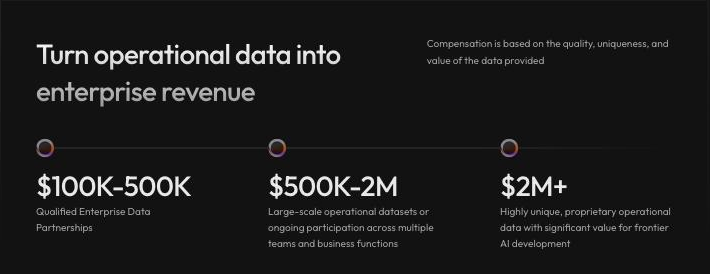
micro1’s payout tiers on its data partnerships page, October 26, 2026.
These are each buyer’s own figures. Our buyer comparison covers who each one takes and what it charges.
micro1’s own page gives three different starting figures for the same deal. We compare them in is micro1 legit?
What have companies actually been paid for their data?
| Company | Paid | Source |
|---|---|---|
| Roofing company | $450,000 | Polyshares case studies |
| General contractor | $300,000 | Polyshares case studies |
| Solar company | $275,000 | Polyshares case studies |
| Global marketing agency | $110,000 | Polyshares case studies |
| Shut-down crypto startup | About $25,000 for code, plus about $15,000 pending for workspace data | MIT Technology Review, October 2026 |
| Spirit Airlines | $10 million winning bid by Google; court approval pending as of October 2026 | MIT Technology Review, October 2026 |
All four Polyshares deals were perpetual exclusive licenses. The gap between the $280,000 median offer and the $31,600 median sale is the most useful number on this page: plan around the lower one until you have a written offer.
Which industries’ data is worth the most?
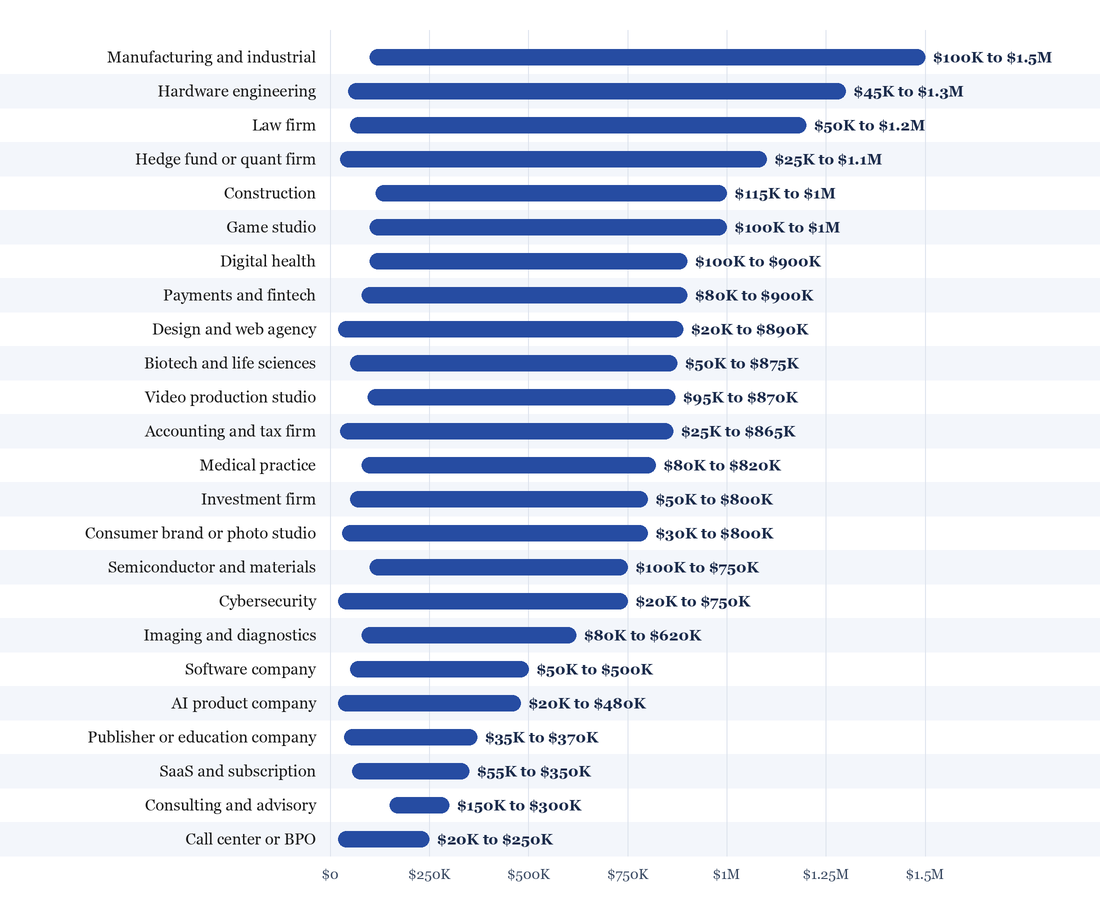
What each kind of company earns on Mercor’s listings, checked October 26, 2026.
| Industry | Company size Mercor lists | Company earns |
|---|---|---|
| Manufacturing and industrial | 20 to 2,000 | $100K to $1.5M |
| Hardware engineering | 20 to 2,000 | $45K to $1.3M |
| Law firm | 5 to 300 | $50K to $1.2M |
| Hedge fund or quant firm | 5 to 500 | $25K to $1.1M |
| Construction | 50 to 2,000 | $115K to $1M |
| Game studio | 10 to 500 | $100K to $1M |
| Digital health | 10 to 500 | $100K to $900K |
| Payments and fintech | Not listed | $80K to $900K |
| Design and web agency | 10 to 200 | $20K to $890K |
| Biotech and life sciences | 10 to 1,000 | $50K to $875K |
| Video production studio | 5 to 500 | $95K to $870K |
| Accounting and tax firm | 5 to 200 | $25K to $865K |
| Medical practice | 10+ clinicians or 2,500+ patients | $80K to $820K |
| Investment firm | 5 to 200 | $50K to $800K |
| Consumer brand or photo studio | 10 to 500 | $30K to $800K |
| Semiconductor and materials | 10 to 2,000 | $100K to $750K |
| Cybersecurity | 20 to 2,000 | $20K to $750K |
| Imaging and diagnostics | Any size | $80K to $620K |
| Software company | 15 to 500 | $50K to $500K |
| AI product company | 5 to 200 | $20K to $480K |
| Publisher or education company | 10 to 500 | $35K to $370K |
| SaaS and subscription | 50 to 1,000 | $55K to $350K |
| Consulting and advisory | 10 to 500 | $150K to $300K |
| Call center or BPO | 50 to 5,000 agents | $20K to $250K |
The highest ceilings go to production, engineering and legal records, and every range is wide. Mercor’s design agency listing says the payout “depends on archive size and rights,” which is true of every row.
What makes company data more valuable?
| Factor | Effect on price | Who says so |
|---|---|---|
| Years of records | More history raises the price | AIData.Broker; micro1 says several years of records make a stronger fit |
| Records that link together | Raises it | AIData.Broker |
| Settled rights | Raises it; unclear rights lower it | AIData.Broker; Mercor |
| Rare, proprietary knowledge | micro1’s $2M+ tier is for highly unique data | micro1 |
| Size, quality and workflow complexity | Raise it | micro1 |
| Exclusive license | About 2.5 to 5 times a non-exclusive deal | AIData.Broker |
| Personal data that can’t be cleared | Lowers it | AIData.Broker |
Do buyers pay per document, per hour or per dataset?
That’s why the ranges above are per company. Video, audio and code sellers are more likely to see per-hour or per-repository pricing.
One-time payment or royalties: which pays more?
Troveo says its datasets sell an average of 4 times. Labelbox Prism splits the difference with an upfront fee at signing plus a revenue share on later use.
A one-time fee is the safer number to plan a business around. Our guide lists each buyer’s payment timing.
Does agreeing to exclusivity raise the price?
Polyshares and Labelbox Prism are exclusive by default, and all four of Polyshares’ published deals were perpetual. Endless Data is non-exclusive, so you can sell the same data again. Ask any buyer requesting exclusivity what it adds to the offer. Our post on AI data licensing agreements shows how to narrow exclusivity if a buyer insists on it.
How can you estimate your data’s value before talking to buyers?
- Find your industry in the table above and note the range.
- Check you meet the size floor. Below it, the range doesn’t apply to you.
- Count your years of complete records. More history moves you up the range.
- Take out anything you can’t license: client work under NDA, HR files, health records.
- Run a free estimate. AIData.Broker values your data from a few questions without any upload, Polyshares has a two-minute check, and DataPaid offers a 60-second estimate.
For what to inventory first, see step 1 of our guide to selling company data.
What are the standard ways to value data?
| Approach | What it measures | How useful for AI data sales |
|---|---|---|
| Cost | What it would cost to recreate the records | Low; buyers don’t pay for your effort |
| Market | What similar data has sold or been offered for | High; buyers’ published ranges and past deals |
| Income | The future revenue the data can earn | Useful only with a revenue-share deal |
Buyers’ published ranges and the deals above are your market evidence. AIData.Broker says every unit price should rest on a sale or offer someone published.
Does selling your data change what your business is worth?
An exclusive or perpetual license matters most here. It means a future owner can’t license that data again, so keep the contract and a record of exactly what you sent. If you’re planning an exit, read our guide to the best places to sell a business.
Common mistakes when valuing company data
The most common mistake is planning around a buyer’s headline range instead of what deals actually pay. These are the others:
- Using Mercor’s referral fees as company payouts. The “You earn” figure is the referrer’s fee; “Company earns” is yours.
- Counting records you can’t license, such as client files under NDA.
- Agreeing to exclusivity without asking what it adds to the price.
- Ignoring broker fees. AIData.Broker’s fee on a $300,000 sale is $35,000 by its own example.
- Expecting the top of a range when you’re near the size floor.
Frequently asked questions
How much is my company’s data worth to AI companies?
Most published ranges run $100,000 to $2 million per company, and Mercor’s industry listings run $20,000 to $1.5 million. The median public sale is far lower, at $31,600 according to AIData.Broker, so treat ranges as ceilings.
What is the average price of company data sold to AI?
AIData.Broker reports a median of $280,000 for buyers’ published offers and $31,600 for the few public sales. Polyshares’ four published deals averaged $283,750.
Which industry’s data is worth the most to AI?
On Mercor’s listings, manufacturers top out at $1.5 million, hardware engineering companies at $1.3 million and law firms at $1.2 million.
Is there a calculator for what my data is worth?
Yes. AIData.Broker, Polyshares, DataPaid and Endless Data all offer free estimates. AIData.Broker’s works without uploading any data.
Is exclusive data worth more?
Yes. AIData.Broker says an exclusive deal fetches about 2.5 to 5 times a non-exclusive one, but you can’t license that data to anyone else for the term.