 Geoff Cudd
Last updated: October 26, 2026
Disclosure: some links on this page are affiliate links. If you sign up through one, we earn a commission at no extra cost to you.
What you will get: the full process for licensing your company’s records to an AI buyer, from checking what you’re allowed to sell to getting paid, with the buyers’ own published prices and terms.
You sell company data to AI companies by licensing it. You list what records you hold, confirm you have the right to license them, apply to a buyer such as micro1 or Mercor, and let the buyer scope and de-identify the files. Then you sign a license, transfer the data and get paid after the buyer accepts it.
Buyers publish payouts from about $20,000 to more than $2 million per company. Where your business lands depends on your industry, how many years of records you kept and whether you own the rights to them.
This guide isn’t legal or tax advice. Have a lawyer review any data license before you sign it.
Key takeaways
- AI labs pay for private business records because the public internet doesn’t show how real work gets done: support tickets, project files, SOPs, code and closed deals.
- Most deals are licenses, not sales. micro1 says companies keep ownership of their underlying data.
- Published payouts run from $20,000 for a small agency archive on Mercor to $2 million or more at micro1.
- Holding data doesn’t mean you have the right to sell it. Client files under NDA, employee messages and personal information are the usual problems.
- Once a model is trained on your data, it can’t practically be pulled back out. Decide what to exclude before you send anything.
Which AI data buyers fit your company?
| Your company | Buyers whose published requirements fit |
|---|---|
| Under 10 employees | Mercor (law, accounting, investment firms and some media and AI product companies, from 5 staff), Polyshares (no headcount minimum), Labelbox Prism and Troveo (no published minimum) |
| 10 to 29 employees | All of the above, plus Mercor’s agency, publisher and consulting listings (10+ staff) and Handshake AI (20+ staff, 3+ years in business) |
| 30 or more employees | All of the above, plus micro1 (30+ full-time), Endless Data (about 30+) and Scale AI (40+ preferred) |
| Closed or shutting down | micro1’s program for companies that are no longer operating, and SimpleClosure AssetHub for startups |
Size is only the first filter. Buyers also look at how many years of records you kept and whether you own the rights to them, which the sections below cover.
Can a business legally sell its data to AI companies?
Daniel Goldberg, a partner at the law firm Frankfurt Kurnit Klein & Selz, puts it plainly in his October 2026 guide. A company that holds data:
“…does not necessarily have the right to sell it.”
Daniel Goldberg, partner, Frankfurt Kurnit Klein & Selz
His guide names the rules that apply most often:
- Your own privacy policy at the time the data was collected. The FTC treats quietly changing it after the fact as potentially deceptive.
- California’s CCPA, which treats handing over personal information as a sale unless the data meets its definition of de-identified.
- HIPAA for health records, GLBA for financial records, and state laws on biometrics and call recording consent.
- GDPR if any of the records cover people in the EU.
What kinds of company data do AI companies buy?
Mercor lists the data it wants by industry on its referral page, along with company size and the range each kind of company earns. This is a selection of its 24 listings, checked October 26, 2026.
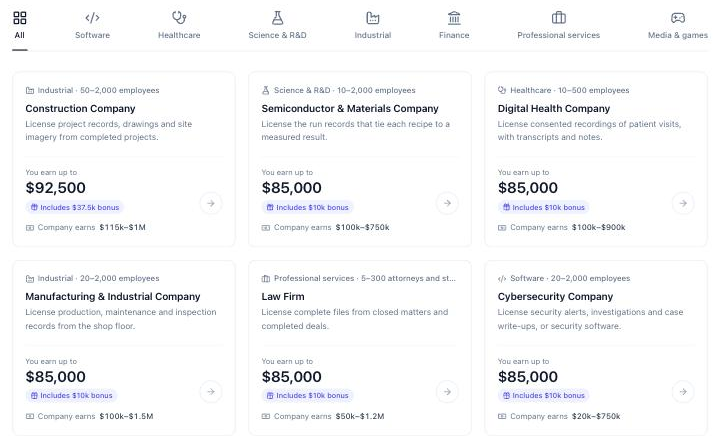
Mercor’s listings page. “You earn” is the referral fee; “Company earns” is what the business is paid.
| Business type | Data Mercor licenses | Company size | Company earns |
|---|---|---|---|
| Construction company | Project records, drawings and site photos from completed projects | 50 to 2,000 employees | $115K to $1M |
| Manufacturer | Production, maintenance and inspection records | 20 to 2,000 employees | $100K to $1.5M |
| Law firm | Complete files from closed matters and completed deals | 5 to 300 attorneys and staff | $50K to $1.2M |
| Medical practice | De-identified patient records with years of physician notes | 10+ clinicians or 2,500+ patients | $80K to $820K |
| Accounting and tax firm | Tax returns, workpapers and bookkeeping records | 5 to 200 employees | $25K to $865K |
| Design and web agency | Design systems, shipped websites and the code behind them | 10 to 200 employees | $20K to $890K |
| Publisher or education company | Journals, textbooks, courses and video you hold the rights to | 10 to 500 employees | $35K to $370K |
| Software company | Private code and its history | 15 to 500 employees | $50K to $500K |
| Consulting firm | Client deliverables, models and the drafts behind them | 10 to 500 employees | $150K to $300K |
| Call center | Recorded customer conversations | 50 to 5,000 agents | $20K to $250K |
micro1 takes a broader view. Its data partnerships page lists SOPs, process documentation, support tickets, CRM records, contract workflows, engineering workflows and internal communications, from any industry.
For why AI companies want these records at all, see what AI training data is and why AI companies pay for it.
What company data can’t you sell?
The most common traps:
- Client work you can’t license. Mercor’s own design agency listing rules out “client work you can’t license” and asks whether the work is “your own or cleared with clients.”
- Records you hold for clients. Polyshares says its license “does not cover what you hold on behalf of your own clients,” and Endless Data never licenses client books or privileged client matter content.
- Email and chat that quote other companies’ confidential information.
- Data pulled through a software vendor’s API. Goldberg’s guide flags Slack’s API terms as one example of platform rules that limit what you can do with exported data.
- HR records. MIT Technology Review reported in October 2026 that data suppliers say they leave employee records out.
- Anything high risk that you’re hoping de-identification will fix.
“Exclude high-risk data entirely rather than relying on de-identification.”
Daniel Goldberg, partner, Frankfurt Kurnit Klein & Selz
Who buys company data for AI?
| Buyer | Type | Published company payout | Who it fits | Exclusivity | Fee to you |
|---|---|---|---|---|---|
| micro1 | Training-data company | $100K to $2M+ | 30+ full-time staff, English records | Not published | None stated |
| Mercor | Training-data company | $20K to $1.5M, by industry | 5+ staff for some industries, more for others | Not published | None, Mercor covers extraction costs |
| Polyshares | Direct buyer | $100K to $2M typical | Any company with a real operating history | Exclusive by default | None |
| Endless Data | Aggregator, licenses to several labs | Up to $4M | About 30+ staff, several years of records, English | Non-exclusive | None |
| Labelbox Prism | Data licensing | About $50K to $1M+ | Not published | Exclusive by default | Not published |
| Handshake AI | Training-data company | $100K to $4M paid to date | 20+ staff, 3+ years in business | Not published | Not published |
| Scale AI | Training-data company | $10K to $1M+ (illustrative) | 40+ staff preferred | Not published | Not published |
| Troveo | Licensing agent, revenue share | Full-company deals start at six figures | Not published | Time-limited, earned | No fees, paid from its revenue share |
| SimpleClosure AssetHub | Broker, mainly startups | Tens to hundreds of thousands | Operating or shutting down | Not published | A percentage on success |
Figures are from each buyer’s own site, checked October 26, 2026. “Not published” means the buyer’s pages don’t say. For a profile of each buyer, plus three brokers not listed here, see our comparison of companies that buy business data for AI.
Big deals do happen directly. Google won the August 2026 auction for Spirit Airlines’ data with a $10 million bid, outbidding Mercor, though the bankruptcy court hadn’t approved the sale as of mid-October 2026. The archive included 100 million emails and 500 million Teams messages.
How much do AI companies pay for company data?
micro1 publishes three tiers:
- $100,000 to $500,000 for a qualified enterprise data partnership
- $500,000 to $2 million for large-scale operational datasets or ongoing participation across several teams
- $2 million and up for highly unique, proprietary data
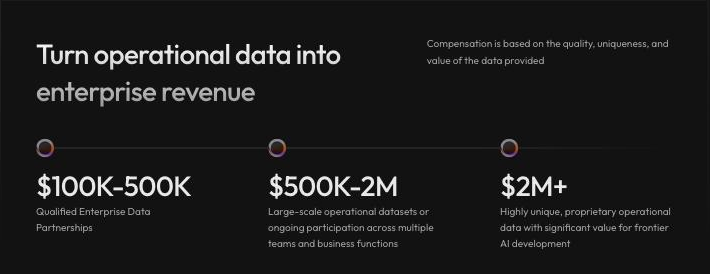
micro1’s payout tiers on its data partnerships page, October 26, 2026.
Reported deals come in lower than the ceilings. MIT Technology Review’s October 2026 report describes a shut-down crypto startup that got about $25,000 for its code base, with about $15,000 more pending for its workspace data. For every industry’s range and what moves the price, see how much company data is worth to AI.
Buyers price on the same things: how many years of records you have, how complete the files are, how rare the expertise is, and whether you hold clear rights. Mercor’s design agency listing says the payout “depends on archive size and rights.”
How to sell your company’s data, step by step
Before you apply
Before you apply
Before you apply
micro1 asks for a company profile, a data manifest and an AI interview
Polyshares says it makes offers within 1 to 2 weeks
Have a lawyer review it first
Mercor pays 2 to 4 weeks after signing. micro1 can take about 60 days after transfer
Step 1: Inventory what you hold
List each data set by system, record count and start date. That’s the format Goldberg recommends, and it’s close to the “data manifest” micro1 asks companies to fill in when they apply.
Include where each set lives (Google Drive, Slack, your CRM, a project management tool) and roughly how many years it covers.
Step 2: Confirm you have the right to license it
Read your client contracts, vendor agreements, software terms and the privacy policy that was live when you collected the data. Look for confidentiality clauses, ownership of deliverables and limits on transferring data.
If your employees are unionized, check the collective bargaining agreement too. Goldberg notes it can restrict a data sale.
Step 3: Decide what to leave out
Mark the records you won’t license at any price: HR files, health records, anything under NDA, and anything you can’t clear with clients. It’s easier to hold a line you drew before an offer arrives.
Step 4: Apply to one or more buyers
Apply through each buyer’s company page. micro1 asks your point of contact to set up a company profile, complete a data manifest and take an AI interview before a human reviews the application.
You can apply to micro1 here or start with Mercor’s company page.
Before you apply to micro1, read our check of whether micro1 is legit, which covers its funding, reviews and the license terms it doesn’t publish. For Mercor, see is Mercor legit, which covers its 2026 breach and how its data program works.
Step 5: Get a scoped offer
The buyer reviews your manifest and samples, then makes an offer based on the data’s size, quality and rarity. Mercor says it signs an NDA and scopes the data itself before the export.
Ask for the offer in writing, with the exact data sets, the price and the payment trigger.
Step 6: Sign a license with privacy and deletion terms
The license should name what the buyer can do with the data, whether it’s exclusive, who removes personal information, how long raw data is kept and when it’s deleted. Have a lawyer review it. Our AI data licensing agreement checklist lists every clause to check.
Goldberg’s guide says privacy and security representations “deserve careful attention,” and that you should require de-identification to be certified “to the company’s satisfaction.”
Step 7: Transfer the data and invoice
Transfer the agreed data, wait for the buyer to accept it, then invoice. micro1 says it has 30 days to review and approve the data, then pays within 30 days of your invoice.
Do you sell the data outright or license it?
Most AI data deals are licenses, not outright sales. You keep ownership and grant the buyer the right to use copies of the records for agreed purposes. micro1 states that “companies retain ownership of their underlying data,” and Mercor describes every listing as licensing.
The license still matters as much as a sale would. A trained model can’t give your data back, so the use terms and the exclusions are your real protection.
How long does it take to sell company data?
No AI data buyer guarantees how long a deal takes, and the payment step alone can run about two months. micro1’s terms allow up to 30 days to approve delivered data and up to 30 more to pay after you invoice, so plan on roughly 60 days between transfer and cash.
Some buyers publish faster timelines:
| Buyer | What it says about timing |
|---|---|
| Polyshares | Offer within 1 to 2 weeks; paid net 30 to 60 days after approval |
| Handshake AI | Pricing in 12 to 24 hours; process takes 7 to 14 business days |
| Mercor | Paid typically within 2 to 4 weeks of the signed agreement |
| micro1 | Up to 30 days to approve data, then paid within 30 days of invoice |
micro1 says there’s “no guaranteed timeframe” between application and a completed partnership, because it depends on your data, legal review and how fast you finish each step.
Who removes personal information, you or the buyer?
Every buyer below says it does this work itself:
| Buyer | How it handles personal information |
|---|---|
| micro1 | De-identifies after transfer; you don’t need to anonymize first |
| Mercor | Automated extraction and anonymization; buyers never see raw data |
| Endless Data | Strips identifiers before data leaves your company |
| Scale AI | Anonymizes inside your environment before extraction |
| Polyshares | A specialist PII partner strips records before any lab sees them |
| Labelbox Prism | PII scrubbing during ingestion |
| Handshake AI | Removes direct and indirect identifiers, and says no process removes the risk entirely |
Don’t hand that job over blind. Goldberg points out that de-identified records can still be linked back to individuals or small groups, which is why he recommends excluding high-risk data entirely and requiring certification of the de-identification.
How do you send the data to the buyer securely?
Send data through the buyer’s approved transfer method, not by giving its tools access to your live systems. micro1 says data moves through its APIs “or other approved methods,” and Goldberg’s guide advises companies to “avoid giving buyer tools direct access to company systems.”
Export a fixed copy of only the approved data sets, and keep a record of exactly what went out.
How and when do you get paid?
Each buyer structures it differently:
| Buyer | How it pays | When |
|---|---|---|
| Mercor | Wire on delivery of the anonymized data | Typically 2 to 4 weeks after signing |
| micro1 | In full after the data is accepted | Within 30 days of invoice, after up to 30 days of review |
| Polyshares | One license fee | Net 30 to 60 days after approval |
| Endless Data | Fixed sum agreed before anything is shared | After transfer |
| Labelbox Prism | Upfront fee plus revenue share on later use | Fee at signing |
| Troveo | Share of revenue on every sale | Not published |
| Handshake AI | Milestone payments | Set in each agreement |
Is money from selling company data taxable?
Payment for licensing your company’s data is business income, and you should plan for tax on it. How it’s reported, and whether any of it can be treated differently, depends on your business structure and the deal terms. Ask your CPA before you sign, not after the wire lands.
Can you sell the same data to more than one AI company?
You can license the same data to more than one AI company only if your first license is non-exclusive. Some buyers ask for exclusivity and some don’t, so read that clause before you sign.
Endless Data’s license is non-exclusive and says “you can license the same data to anyone else.” Polyshares and Labelbox Prism are exclusive by default, and Polyshares’ four published deals were all perpetual exclusive licenses. Troveo grants exclusivity only for a limited time.
If a buyer wants exclusivity, ask what it adds to the price. An exclusive license closes off every other buyer for the term.
Do you have to tell your clients or employees?
You may have to tell clients or employees, depending on your contracts, your privacy policy and the law that applies to the data. Even where you’re not required to, Goldberg warns that selling company data “can damage trust” with staff, customers and partners.
Employee messages are a specific risk. Goldberg notes that workplace communications can be protected concerted activity under Section 7 of the National Labor Relations Act. Spirit Airlines’ flight attendants’ union objected to its data sale on privacy grounds, according to MIT Technology Review.
Is old or archived data still worth selling?
Old and archived data is exactly what most buyers ask for, because they want completed work with known outcomes. Mercor’s listings ask for “completed projects” and “closed matters,” and micro1 says companies with “several years of records” are a stronger fit.
Closed businesses can sell too. micro1 runs a separate program for companies that are no longer operating, and SimpleClosure says its Asset Hub has handled over 150 deals for shutting-down startups, according to MIT Technology Review.
Is there a minimum company size or amount of data?
Minimums depend on the buyer. micro1 wants 30 or more full-time employees and says it has no fixed minimum number of files. Mercor’s listings start at 5 employees for law, accounting and investment firms, and 10 for design agencies and publishers.
Language and location count too. micro1 wants data that’s primarily in English and is prioritizing US companies, followed by other Western markets.
Do you need a lawyer to sell company data?
Yes, have a lawyer review any data license before you sign it. The contract decides who owns what, how your data can be used, who’s liable if personal information leaks and whether you can ever get the data back. Goldberg’s guide also recommends involving privacy, security, HR and communications, not just business development.
Keep a record of the decision too. Goldberg notes that a past data sale will come up in due diligence if you ever sell the business.
Can you ask the buyer to delete your data later?
You can ask a buyer to delete its copies of your raw data, if the license gives you that right, but you can’t remove the data from a model already trained on it. micro1 says it deletes raw data on an agreed retention schedule and honors deletion requests under the engagement terms.
Goldberg is blunt about the limit. Once data is used to train a model:
“…it cannot practically be pulled back out.”
Daniel Goldberg, partner, Frankfurt Kurnit Klein & Selz
Treat every record you send as permanent.
For the other risks, from buyer breaches to re-identification, see is selling company data to AI safe.
Common mistakes when selling company data to AI
The most common mistake is sending data before confirming you have the right to license it. The rest follow the same pattern of moving faster than the paperwork:
- Accepting a fast offer before the inventory and rights check are done.
- Relying on the buyer’s de-identification without reviewing samples yourself.
- Giving the buyer’s tools direct access to live systems instead of exporting a fixed copy.
- Signing an exclusive license without a higher price to match.
- Forgetting the privacy policy that was live when the data was collected.
- Not telling staff, then having them hear about it from someone else.
- Treating the headline payout as a quote. The small startup deal MIT Technology Review reported came to about $40,000, well under most buyers’ top figures.
Frequently asked questions
Can a small business sell its data to AI companies?
Yes, if it fits a buyer’s size and data requirements. Mercor’s listings start at 5 employees for law, accounting and investment firms. micro1 wants 30 or more full-time employees.
Do I need to anonymize my data before selling it?
Not always. micro1 and Mercor both say they remove personal information themselves. You should still exclude high-risk records and check samples of the de-identified data.
Can a closed business sell its data?
Yes. micro1 runs a program for companies that are no longer operating, and SimpleClosure says its Asset Hub has handled over 150 deals for startups, many of them shutting down.
What is a data manifest?
A data manifest is micro1’s term for the summary of your data that a company completes when it applies: what systems you use, what records you hold and how far back they go.
Can AI companies use my data to build a competing product?
They can unless the license stops them. Set the allowed uses and any limits on competing products in the contract, because trained models can’t be untrained.