 Geoff Cudd
Last updated: October 26, 2026
Disclosure: some links on this page are affiliate links. If you sign up through one, we earn a commission at no extra cost to you, and affiliate partners can appear higher in our rankings.
The companies that buy business data for AI in 2026 fall into three groups: buyers such as micro1, Mercor and Polyshares; aggregators such as Endless Data; and brokers such as Korra and AIData.Broker that find buyers for you. Published payouts run from $10K to $4M per company.
For small firms, Mercor and Polyshares have the lowest size limits. For keeping the right to sell to more than one buyer, Endless Data is the only buyer with a non-exclusive license by default.
We compared 12 buyers using each company’s own website, checked October 26, 2026. We haven’t sold data to any of them. If you’re new to this, start with our guide on how to sell your company’s data to AI companies.
Key takeaways
- Mercor and Polyshares take the smallest companies. Mercor’s listings start at 5 staff, and Polyshares has no headcount minimum.
- Endless Data is the only buyer here that is non-exclusive by default. Polyshares and Labelbox Prism are exclusive by default.
- Brokers charge fees, and buyers mostly don’t. AIData.Broker takes 12% of the first $250,000, and Datarade’s marketplace takes 15% to 30%.
- Several big names don’t buy company files at all. Surge AI, Turing and Snorkel AI hire contractors to make training data.
- Payouts are ranges, not quotes. Polyshares’ published deals ran $110,000 to $450,000, against a $100K to $2M headline.
How do the 12 buyers compare?
| Buyer | Type | Published company payout | Who it fits | Exclusivity | Fee to you |
|---|---|---|---|---|---|
| micro1 | Buyer | $100K to $2M+ | 30+ full-time staff | Not published | None stated |
| Mercor | Buyer | $20K to $1.5M by industry | 5+ staff (some industries) | Not published | None |
| Polyshares | Direct buyer | $100K to $2M typical | No minimum | Exclusive by default | None |
| Endless Data | Aggregator | Up to $4M | About 30+ staff | Non-exclusive | None |
| Korra | Broker | $200K to $2M typical | Small companies OK | Your choice | Agreed in writing |
| AIData.Broker | Broker | $25K base case minimum | US, UK, Canada | Your choice | 6% to 12% of the sale |
| DataPaid | Introducer | $100K to $2M | 25+ office staff best fit | Not stated | None (buyers pay it) |
| Handshake AI | Buyer | $100K to $4M paid to date | 20+ staff, 3+ years | Not published | Not published |
| Labelbox Prism | Buyer | About $50K to $1M+ | Not published | Exclusive by default | Not published |
| Scale AI | Buyer | $10K to $1M+ (illustrative) | 40+ staff preferred | Not published | Not published |
| Troveo | Licensing agent | Six figures and up | Not published | Time-limited | No fees; takes a revenue share |
| SimpleClosure AssetHub | Broker for startups | Tens to hundreds of thousands | Startups | Not published | Percentage on success |
Figures come from each company’s own site, checked October 26, 2026. “Not published” means the site doesn’t say. For what deals actually pay, see how much company data is worth to AI.
Which buyer fits your company size?
| Your company | Buyers whose published requirements fit |
|---|---|
| Under 10 employees | Mercor (law, accounting and investment firms from 5 staff), Polyshares, Korra, and Labelbox Prism and Troveo (no published minimum) |
| 10 to 29 employees | All of the above, plus Mercor’s agency, publisher and consulting listings and Handshake AI (20+ staff, 3+ years) |
| 30 or more employees | All of the above, plus micro1, Endless Data, DataPaid (25+ office staff) and Scale AI (40+ preferred) |
| Closed or shutting down | micro1’s program for companies no longer operating, and SimpleClosure AssetHub for startups |
1. micro1
Best for established companies with 30+ staff
What it buys
micro1 licenses operational data from any industry: SOPs, process documentation, support tickets, CRM records, contract workflows, engineering workflows and internal communications.
What it pays
micro1 publishes three tiers: $100K to $500K, $500K to $2M and $2M and up, and says payments typically run $150K to over $2M. It has up to 30 days to approve data, then pays within 30 days of your invoice.
Who it fits
micro1 wants 30+ full-time employees and mostly English records, and is prioritizing US companies. It also runs a separate program for companies that are no longer operating.
Terms to know
Companies keep ownership of their data. micro1 de-identifies the data itself, deletes raw data on an agreed schedule and licenses only to buyers in the US and allied countries.
For micro1’s funding, reviews and the risks in its terms, read our answer to is micro1 legit.
micro1 Pros
- Published payout tiers
- You don’t need to anonymize data first
- Program for closed companies
micro1 Cons
- 30+ full-time staff required
- Exclusivity terms not published
2. Mercor
Best for small professional firms: published payouts by industry
What it buys
Mercor licenses records from Slack, Gmail, Salesforce, GitHub and Notion, plus industry files such as contracts, case files, clinical notes and project records. Its listings page names 24 industries it’s buying from.
What it pays
Mercor’s listings put company payouts between $20K and $1.5M depending on the industry, such as $50K to $1.2M for law firms and $25K to $865K for accounting firms. Law firms face extra ethics rules, covered in our guide to selling law firm data to AI. It pays by wire on delivery, typically within 2 to 4 weeks of signing.
Who it fits
Size floors start at 5 staff for law, accounting and investment firms and 10 for agencies and publishers. Construction listings start at 50. Our guide to selling construction company data to AI covers what contractors can and can’t license.
Terms to know
Mercor covers extraction, anonymization and transfer costs, with no deductions from the payment. It doesn’t publish its exclusivity terms.
For Mercor’s funding, its 2026 breach and its lawsuits, read our answer to is Mercor legit.
Mercor Pros
- Payout ranges published for 24 industries
- Lowest size floors of the big buyers
- No fees or costs to the seller
Mercor Cons
- Exclusivity and deletion terms not published
- Payouts vary widely inside each range
Best for companies of any size with a long operating history
What it buys
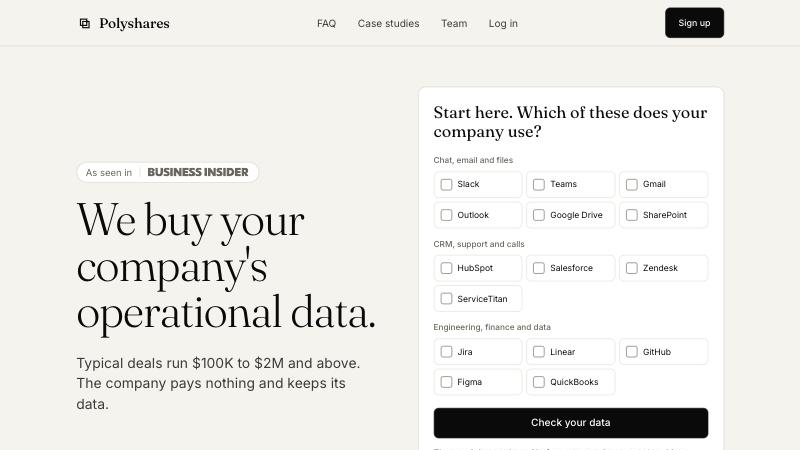
Polyshares buys licenses to operational records: Slack and Teams, Google Drive and SharePoint, email, CRM history, support tickets, design files, call recordings and accounting exports. Its license doesn’t cover records you hold for your own clients.
What it pays
Polyshares says typical deals run $100K to $2M. Its four published deals ranged from $110,000 (a marketing agency) to $450,000 (a roofing company). It pays one license fee, net 30 to 60 days after the data is approved.
Who it fits
Polyshares has no headcount or revenue minimum. It says the length of your records matters more than size.
Terms to know
Licenses are exclusive by default, and its published deals were perpetual exclusive licenses. A specialist partner strips personal information before any lab sees it. There’s no fee, because Polyshares is the buyer.
Polyshares Pros
- No headcount minimum
- Published deal history with real amounts
- No fee or commission
Polyshares Cons
- Exclusive by default, and published deals were perpetual
- One payment, no ongoing revenue
4. Endless Data
Best for keeping the right to sell to other buyers
What it buys
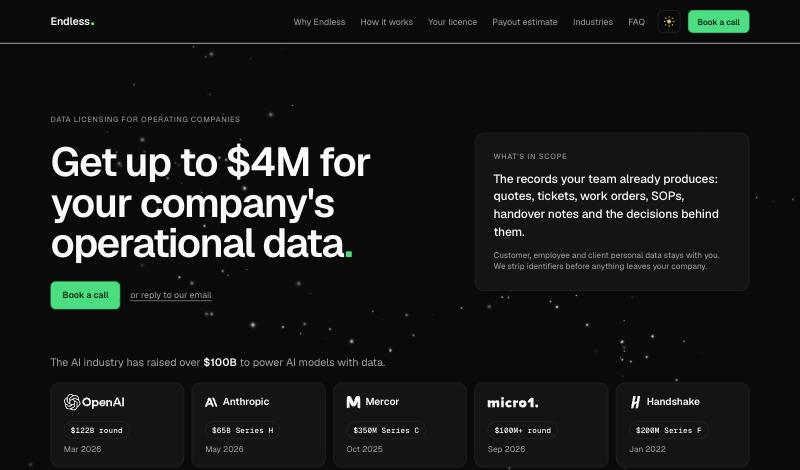
Endless Data licenses the records teams already produce: quotes, tickets, work orders, SOPs, handover notes and the decisions behind them. It never licenses customer, employee or client personal data, health records, privileged client matter content or client books.
What it pays
Endless Data advertises up to $4M, and agrees a fixed sum with you before anything is shared. The range for your company only shows after you enter a work email.
Who it fits
Endless Data looks for roughly 30 or more employees, several years of history and English documentation, with priority for the US, UK and Canada.
Terms to know
The license is non-exclusive, so you can license the same data elsewhere. Endless Data strips identifiers before data leaves your company, deletes it at the end of the term and is paid by the labs, not by you.
Endless Data Pros
- Non-exclusive license
- Fixed price agreed before you share anything
- Personal data never licensed
Endless Data Cons
- Payout range hidden behind an email form
- About 30+ staff needed
5. Korra
Best for small companies that want a broker to find buyers
What it buys
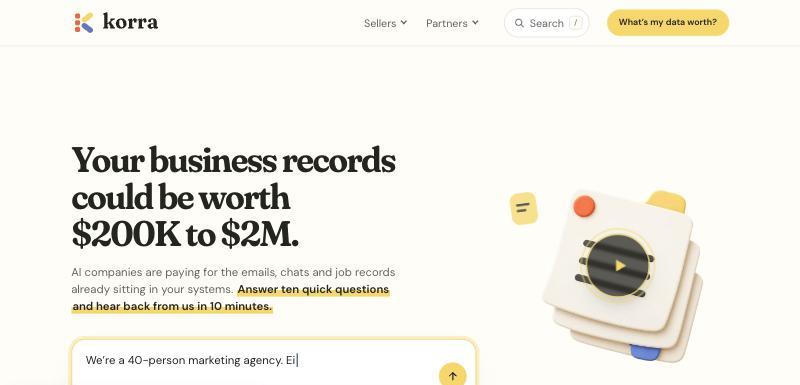
Korra is a broker, not a buyer. It connects you with buyers for team chat, business email, sales records, support, documents, approved call transcripts and operational workflows.
What it pays
Korra says the typical range is $200K to $2M, and that no sale is guaranteed. Payment can come in as little as 7 days, and usual terms are net 30.
Who it fits
Korra takes small companies and only records your business owns. Client files held by agencies, accountants or law firms usually don’t qualify.
Terms to know
You choose whether a license is exclusive, and you decide what stays out. Korra’s fee is agreed in writing before you sign, with nothing paid up front.
Korra Pros
- Small companies welcome
- You choose exclusive or not
- Nothing paid up front
Korra Cons
- Fee isn’t published
- You prepare the data yourself
6. AIData.Broker
Best for transparent broker fees
What it buys
AIData.Broker is a sell-side broker. It puts your company records, code or archives in front of the buyers on its board and negotiates for you, but never buys or resells the data itself.
What it pays
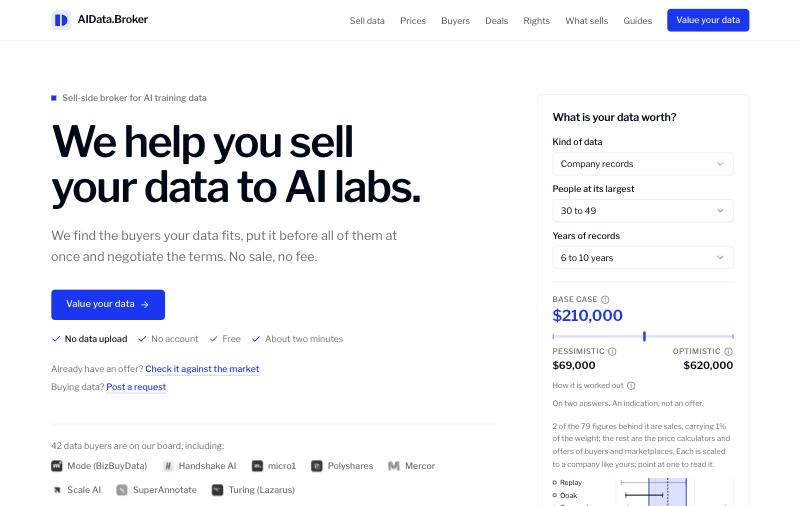
AIData.Broker’s sample valuation for a 30 to 49 person company with 6 to 10 years of records is $69,000 to $620,000, with a $210,000 base case. It only takes a sale when the base case is at least $25,000.
Who it fits
AIData.Broker works with holders in the United States, the United Kingdom and Canada.
Terms to know
Its fee is 12% of the first $250,000, 10% up to $1M, 8% up to $3M and 6% above that, with no fee if no sale closes. You remove personal information yourself, on your own computer, to its published standard.
AIData.Broker Pros
- Published, tiered fee
- No sale, no fee
- Pitches you to many buyers at once
AIData.Broker Cons
- You do the de-identification
- US, UK and Canada only
7. DataPaid
Best for an introduction to several buyers at once
What it buys
DataPaid is an independent data licensing partner. It introduces companies to AI data buyers for Slack, email archives, support tickets, Jira, source code, SOPs, CRM, knowledge bases and call recordings.
What it pays
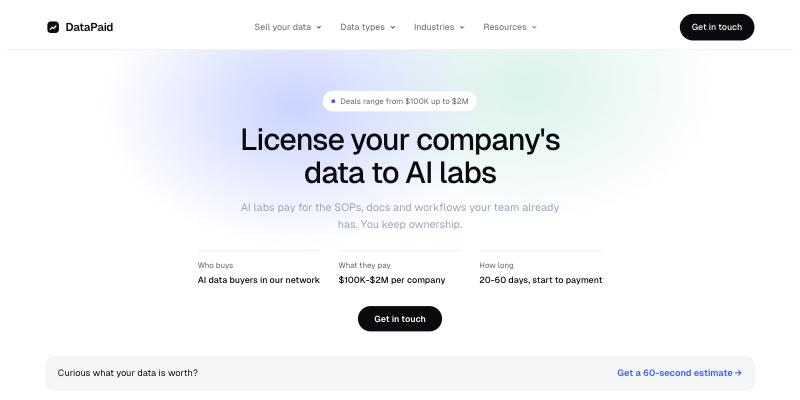
DataPaid quotes $100K to $2M per company, using buyers’ published tiers, and says the process typically takes 20 to 60 days from discovery to payment. The buyer pays you directly.
Who it fits
DataPaid’s strongest fit is companies and nonprofits with 25+ office employees and at least 70% English-language data, across the US, Canada, the EU, the UK and several other markets.
Terms to know
DataPaid doesn’t charge the seller. Buyers in its network may pay it a fee when a company it introduces signs.
DataPaid Pros
- No fee to the seller
- Covers many countries
- Published timeline of 20 to 60 days
DataPaid Cons
- Its payout figures are buyers’ published tiers, not its own
- Exclusivity not stated
8. Handshake AI
Best for established firms that want help pricing their data
What it buys
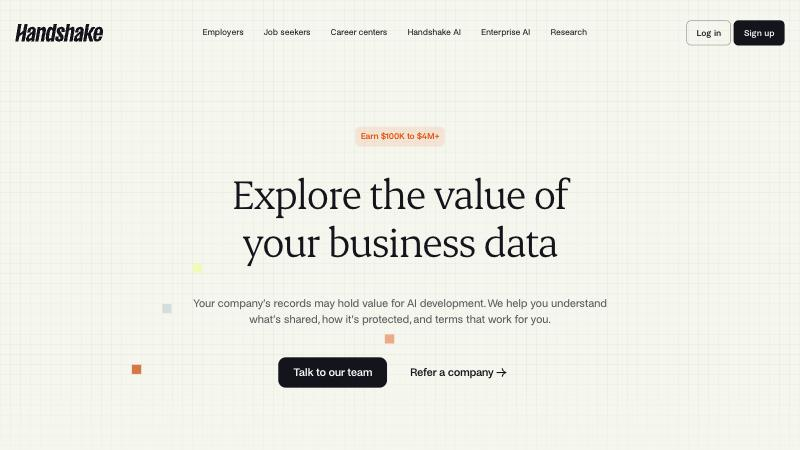
Handshake AI licenses internal business data such as documents, communications and records of business processes, including financial models and underwriting workflows.
What it pays
Handshake AI says payments to date have ranged from $100K to $4M. It ties payment to delivery milestones in each agreement, and says it can price data in 12 to 24 hours.
Who it fits
Handshake AI says companies with 20+ employees and 3+ years of operating history are more likely to be a fit.
Terms to know
Handshake AI is contractually limited to using the data for AI training and evaluation. It removes identifiers and is open that no de-identification process removes the risk entirely.
Handshake AI Pros
- Fast pricing
- Use limited to training and evaluation
- Help with data transfer at no cost
Handshake AI Cons
- Exclusivity and fees not published
- 20+ staff preferred
9. Labelbox Prism
Best for ongoing revenue from your data
What it buys
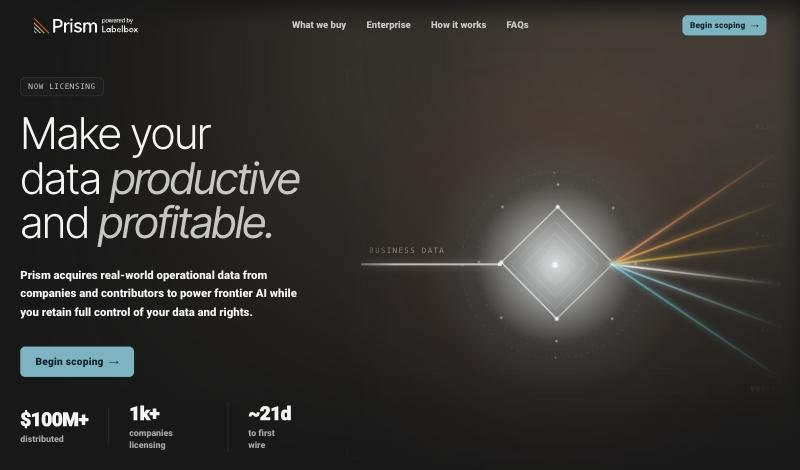
Labelbox Prism licenses operational data from tools such as Salesforce, Jira, Slack, SAP, CAD and financial workbooks, plus coding sessions and research workflows. HR data, performance reviews and compensation are excluded by default.
What it pays
Prism says smaller targeted datasets start around $50K and enterprise partnerships reach $1M+. It pays an upfront fee at signing plus a revenue share on later use.
Who it fits
Prism doesn’t publish size or location requirements, and says scoping is free.
Terms to know
Licenses are exclusive by default. A kill clause forces deletion within 30 days for breach, regulatory change or a change of control, but models already trained on the data can’t be unlearned.
Labelbox Prism Pros
- Upfront fee plus revenue share
- 30-day deletion clause
- HR data excluded by default
Labelbox Prism Cons
- Exclusive by default
- No published eligibility rules
10. Scale AI
Best for larger companies that want a recurring partnership
What it buys
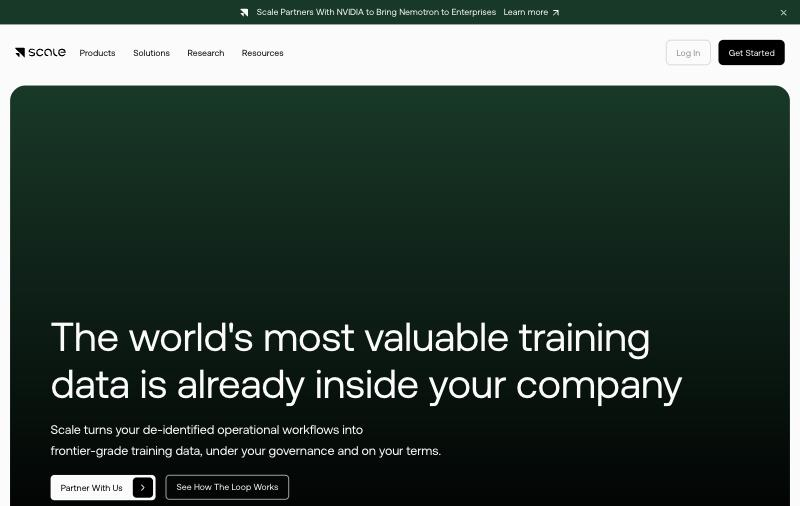
Scale AI licenses structured, de-identified records from your operational workflows, such as email threads and event details, but never the raw systems themselves.
What it pays
Scale AI gives an illustrative $10K to $1M+ per partnership, scaling with how often data is delivered. It designs partnerships for recurring revenue rather than a one-time transfer.
Who it fits
Scale AI says 40+ employees is its preferred starting point, judged case by case, and asks for years of records.
Terms to know
Scale anonymizes everything inside your environment before any data is extracted. Its exclusivity, term and fees aren’t published.
Scale AI Pros
- Anonymizes inside your systems
- Recurring revenue model
- Can start with a small scope
Scale AI Cons
- 40+ staff preferred
- Terms and fees not published
11. Troveo
Best for selling the same data to several buyers
What it buys
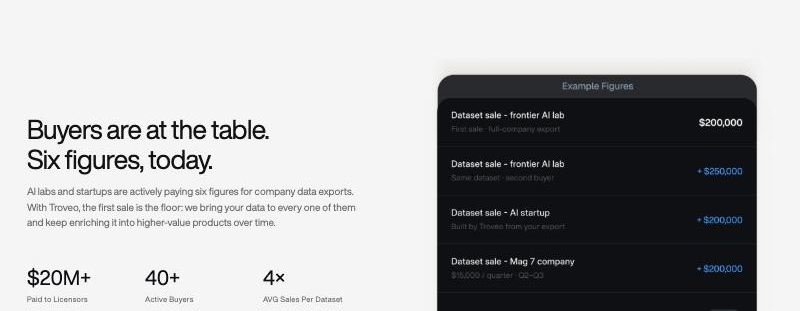
Troveo licenses your data on your behalf: chat and messaging, email and calendar, documents, CRM, sales and support, finance and operations, and code.
What it pays
Troveo says typical full-company deals start at six figures, and you share in the revenue on every sale. Its site shows $20M+ paid to licensors across all data types.
Who it fits
Troveo doesn’t publish size requirements. Its estimator asks for employee count and years operating.
Terms to know
Ownership never transfers. Any exclusivity is time-limited, and Troveo charges no fees, earning its share from each sale. Names, contact details and client identities are scrubbed to its standard.
Troveo Pros
- Paid on every resale
- No fees or setup costs
- Exclusivity only time-limited
Troveo Cons
- Its revenue share isn’t published
- Payment timing not stated
12. SimpleClosure AssetHub
Best for startups winding down
What it buys
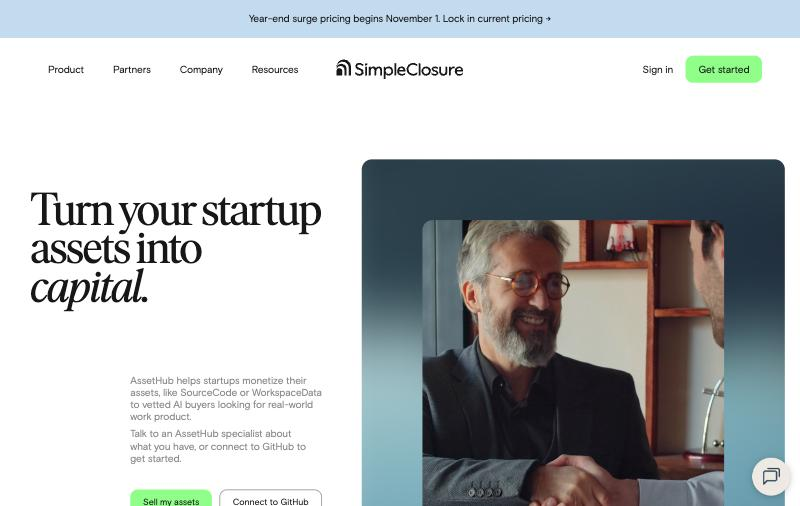
SimpleClosure’s AssetHub sells or licenses startup code and workspace data, including communications, documents, designs, tickets and workflows from tools such as Slack, Google Drive, email, Notion and Figma.
What it pays
AssetHub says unique assets sell for tens to hundreds of thousands of dollars. MIT Technology Review reported it has handled over 150 deals.
Who it fits
You don’t need to be shutting down to sell, but AssetHub is built for startups.
Terms to know
There’s no upfront cost. SimpleClosure takes a percentage only if your assets sell or license, and doesn’t publish the rate. Sensitive employee, compensation and health information is excluded.
SimpleClosure AssetHub Pros
- No upfront cost
- Built for startups that are closing
- Can license or sell outright
SimpleClosure AssetHub Cons
- Success fee rate not published
- Payment timing not stated
Do OpenAI, Anthropic and Google buy data directly from businesses?
Mercor says it licenses and packages company data for “frontier labs”, and micro1 licenses only to labs and enterprises in the US and allied countries. If your archive isn’t the size of an airline’s, start with one of them. For why labs want business records in the first place, read what is AI training data.
What’s the difference between a data buyer, a broker and a marketplace?
| Type | Who you sign with | Examples |
|---|---|---|
| Buyer or training-data company | The buyer | Mercor, micro1, Polyshares, Handshake AI, Labelbox Prism, Scale AI |
| Aggregator | The aggregator, which licenses to several labs | Endless Data |
| Broker or agent | The end buyer, with the broker’s help | Korra, AIData.Broker, DataPaid, Troveo, SimpleClosure AssetHub |
| Marketplace | Each buyer, through the platform | Datarade, Defined.ai |
Marketplaces suit packaged datasets more than a one-off archive of company records. Datarade charges either 30% commission with no annual fee, or $6,000 a year plus 20%, or $12,000 a year plus 15%. Defined.ai runs a Data Partner program for audio, video, image and text data, but doesn’t publish its revenue share.
Which buyers charge fees, and how much?
| Company | Fee to the seller |
|---|---|
| Mercor, Polyshares, Endless Data | None |
| DataPaid | None; buyers may pay DataPaid when a company it introduces signs |
| Troveo | No fees; it keeps a share of each sale |
| AIData.Broker | 12% of the first $250,000, 10% to $1M, 8% to $3M, 6% above |
| Korra | Agreed in writing before you sign |
| SimpleClosure AssetHub | A percentage on success, rate not published |
| Datarade | 30% commission, or $6,000 to $12,000 a year plus 15% to 20% |
On a $300,000 sale, AIData.Broker’s fee is $35,000 by its own example. Ask every broker for the fee in writing before you share data.
Do buyers pay up front, per use or as royalties?
One fee is simpler and arrives sooner. Revenue shares can pay more over time but depend on how often the data resells. Our guide to selling company data lists each buyer’s payment timing.
Which buyer fits which industry?
| Industry | Where to start |
|---|---|
| Law, accounting and investment firms | Mercor (from 5 staff), Polyshares |
| Design agencies and publishers | Mercor (from 10 staff), Polyshares |
| Construction and manufacturing | Mercor (from 50 and 20 staff), Polyshares, Endless Data |
| Finance teams with models and underwriting files | Handshake AI |
| Startups, operating or closing | SimpleClosure AssetHub, micro1’s program for closed companies |
| Healthcare, video and audio data | Protege, which licenses media and clinical data |
Which AI data companies don’t buy company data?
Surge AI’s jobs page lists contractor roles, Turing hires independent contractors, and Snorkel AI says better data is “developed, not collected.” If you search for buyers and land on a page asking you to apply as an expert, it’s a job, not a data deal.
How do you check that a data buyer is legitimate?
Ask each buyer these questions before you send data:
- Who signs the license, you or the end buyer?
- Is the license exclusive, and for how long?
- Who removes personal information, and can I review samples first?
- Who will the data be licensed to, and for what uses?
- When am I paid, and what triggers payment?
- What fee, if any, comes out of my payment?
- Will you delete raw data at the end, and when?
Be wary of anyone asking for live access to your systems or payment from you up front. Our guide covers who removes personal information in more detail. For buyer breaches and the other risks, see is selling company data to AI safe.
Common mistakes when choosing a data buyer
The most common mistake is signing an exclusive license with the first buyer to answer. These are the others that cost sellers money:
- Treating a headline range as a quote. Polyshares’ own published deals sat at the low end of its range.
- Ignoring broker fees until the offer arrives.
- Applying to buyers whose size floor you don’t meet.
- Assuming a broker will remove personal information. Korra and AIData.Broker leave that to you.
- Confusing contractor job ads with data buyers.
Frequently asked questions
What companies buy business data for AI?
Mercor, micro1, Polyshares, Handshake AI, Labelbox Prism and Scale AI buy or license business data directly. Endless Data aggregates it for several labs, and Korra, AIData.Broker, DataPaid, Troveo and SimpleClosure AssetHub find buyers for you.
Which AI data buyer pays the most?
Endless Data and Handshake AI advertise the highest ceilings, at up to $4M. Published deals come in lower: Polyshares’ four case studies ranged from $110,000 to $450,000.
Can a small business sell data to AI companies?
Yes. Mercor’s listings start at 5 staff for law, accounting and investment firms, Polyshares has no headcount minimum, and Korra says small companies are welcome.
Is Datarade a good place to sell company data?
Datarade suits packaged datasets that many buyers might want. It charges 15% to 30% commission depending on the plan, which is more than selling directly to a buyer like Mercor or Polyshares.
Do I have to pay to sell my data?
No buyer on this list charges up front. Brokers take a share only when a sale closes, and marketplaces like Datarade take a commission and sometimes an annual fee.