 Stefan Schulz
ClickSend is a pay-as-you-go business messaging platform that sends SMS, MMS, voice calls, email, fax and physical mail from one dashboard or API. US SMS starts at 2.93 cents a message and falls to 0.96 cents on large credit top-ups, with no subscription, no monthly minimum and no contract.
Two things its pricing page does not make obvious, and both change the real number.
Every rate ClickSend advertises excludes a 0.42 cent per message carrier fee. And the volume discount is tied to how much you top up at once, not how much you send per month, so a small sender who pre-buys credit pays the same rate as a much larger one.
We ran ClickSend ourselves. Here is what it costs, what it does well, and where it stops being the right choice.
ClickSend is the cheapest way to send a few thousand texts a month if you already have your contact list and are comfortable buying credit up front. Choose something else if you need to grow that list from scratch, and expect it to stop winning on price somewhere between 28,000 and 36,000 messages a month.
Note: ClickSend’s US rates moved since our last update. Entry SMS is now 2.93 cents (was listed here as 2.4 cents), a toll-free number is $3.58 a month (was $1.63), and a dedicated short code is $1,038.49 a month plus the same amount again as a setup fee. ClickSend is also no longer independent: it joined MessageMedia in 2019 and the Sinch Group in 2022.

SlickText
- Every feature on every plan, no gated upsells
- Best-in-class list growth: popups, keywords, tap-to-join links, and QR codes
- 4.8/5 with 268 Capterra reviews and Capterra Shortlist 2026

SimpleTexting
- Polished campaign builder with AI writing assistant included on all plans
- Rollover credits, 3 user seats, and 14-day free trial with no credit card
- Strong Zapier and API integrations for marketing automation

Mobile Text Alerts
- Plans from $20/month with unlimited contacts and unlimited users
- 1,000+ integrations and broad team management features
- Popular with churches, schools, and nonprofits
We offer this website completely free to our visitors. To help pay the bills, we’ll often (but not always) set up affiliate relationships with the top providers after selecting our favorites. However, we do our best not to let this impact our choices. There are plenty of high-paying companies we’ve turned down because we didn’t like their product.
An added benefit of our relationships is that we always try to negotiate exclusive discounts for our visitors.
Key Takeaways
- Real entry cost is 3.35 cents a message, not 2.93. The advertised rate excludes a 0.42 cent carrier fee that applies to every SMS on every number type.
- The discount comes from your top-up size, not your send volume. A $20 top-up buys credit at 2.93 cents. A $100 top-up buys it at 2.08 cents, a 29% cut, even if it takes you five months to spend.
- No subscription, no seat fees, free inbound. Unlimited users are included and replies never cost anything, which is rare in this category.
- It is a sending tool, so you bring your own contacts. There are no opt-in keywords, no list-growth widgets and no drip builder.
- You cannot text US numbers on day one. Every US sender needs a registered number, and toll-free registration takes 1 to 7 business days and requires documented proof of opt-in.
- Owned by Sinch since 2022, which makes it a sister product to SimpleTexting.
What Is Clicksend?
ClickSend is a cloud messaging provider that lets businesses send, receive and track messages worldwide without a subscription. You buy credit, you spend it, you top up again.
It handles transactional messages (order updates, appointment reminders, one-time passcodes) and marketing sends from the same account, through either a web dashboard or an API.
ClickSend was founded in 2013 by Matt Larner. MessageMedia acquired it in 2019, and both companies joined the Sinch Group in 2022. Its company page now lists a Melbourne head office, with a US office in Denver.
That ownership matters more than it sounds. Sinch also owns SimpleTexting, so two of the platforms you are probably comparing sit under the same parent, priced for completely different buyers.
How Does ClickSend Work?
You create an account, add credit, and send. There is no plan to choose and no contract to sign.
Businesses can send and receive through the dashboard or API via:
- SMS
- MMS
- Text-to-speech voice calls
- Fax
- Physical letters and postcards
- Rich messaging channels
Developers can integrate through REST, HTTP, SMPP, SMTP, FTP and SOAP. There are also mobile apps for Android and iOS, an Outlook add-in, and prebuilt Zapier workflows.
Also Read: Text Message Marketing Laws
Who Uses ClickSend?
ClickSend suits businesses that already know what they want to send and need a reliable, cheap way to send it. Emergency services, healthcare, logistics, retail, ecommerce, banking and nonprofits are all common.
The pattern is consistent: teams sending high-volume operational messages, or developers wiring SMS into an existing product. If you are looking for SMS marketing software for customer service, ClickSend covers the sending side well but leaves the campaign tooling to you.
What SMS and MMS Features Does ClickSend Offer?
ClickSend’s messaging feature set is deliberately narrow. Every plan includes everything, because there are no plans.
| Capability | What you get |
|---|---|
| Outbound SMS | Single, bulk and scheduled sends from the dashboard or API |
| Inbound SMS | Free on every number type, with two-way replies in the dashboard |
| MMS | Images, animations and audio at 3.80 cents plus a 0.88 cent carrier fee |
| Contact lists | Upload, store and segment lists, with no cap on contacts |
| Users | Unlimited seats and subaccounts, no per-user charge |
| Automation | API triggers and prebuilt Zapier workflows, but no native drip builder |
| List growth | Not included. No opt-in keywords, signup widgets or landing pages |
| Support | 24/7 live chat and email on every account, no paid tier |
The gap at the bottom of that table is the one to pay attention to. ClickSend will deliver your messages reliably and cheaply, but it will not help you collect the phone numbers in the first place. (For the difference between the two message types, see SMS vs MMS.)
What Does ClickSend Cost? (ClickSend Pricing)
ClickSend has no startup fee, no monthly fee and no contract. You pay for what you send, and you buy that capacity in advance as credit.
How Much Does ClickSend Cost Per Text?
The US rate depends entirely on your top-up size. These are the published credit tiers, verified 24 August 2026.
| Top-up | Messages included | Rate per SMS | With carrier fee |
|---|---|---|---|
| $20 | 682 | 2.93c | 3.35c |
| $100 | 4,807 | 2.08c | 2.50c |
| $500 | 24,038 | 2.08c | 2.50c |
| $1,000 | 74,074 | 1.35c | 1.77c |
| $2,000 | 208,333 | 0.96c | 1.38c |
| $3,000 | 312,500 | 0.96c | 1.38c |
| $5,500 | 572,916 | 0.96c | 1.38c |
Notice what happens between the first two rows. Moving from a $20 top-up to a $100 top-up cuts your rate by 29%, and nothing about your business has to change to earn it.
If you send 500 messages a month, a $100 top-up covers you for most of a year at the better rate. That is the single easiest saving available on this platform, and ClickSend does not point it out anywhere.
ClickSend Changed How It Discounts, and Most Articles Missed It
This top-up model is new. As recently as November 2025, ClickSend’s US pricing page discounted on how many messages you sent, not on how much credit you bought:
| Messages sent (Nov 2025) | Price per SMS |
|---|---|
| Under 5,000 | 2.78c |
| 5,000 or more | 1.98c |
| 50,000 or more | 1.29c |
| 150,000 or more | 0.95c |
Three things changed with it. The entry rate went up from 2.78c to 2.93c. The second tier now costs you cash rather than volume: 1.98c used to arrive automatically once you sent 5,000 messages, and its closest equivalent today, 2.08c, requires a $100 top-up whether you send 300 messages or 3,000. And the cheapest rate barely moved, 0.95c to 0.96c, but it now asks for $2,000 up front instead of 150,000 messages sent.
The discount now rewards cash, not volume. That is good news if you can pre-buy and bad news if you cannot, and it is the opposite of how nearly every ClickSend comparison still describes the pricing. If you read a page quoting “under 5k, 2.78 cents”, it is describing a rate card ClickSend retired.
One more thing worth knowing: the November 2025 page offered a free shared number for receiving replies alongside the paid toll-free option. The current pricing page lists only the $3.58 toll-free number and the short code, so ask support whether the free shared number is still available before you budget for one.
The Carrier Fee ClickSend Does Not Put in the Headline Rate
US carriers charge messaging fees that ClickSend passes through. It applies a flat average rather than billing each carrier separately, which keeps the invoice readable but means the fee is unavoidable.
- SMS: 0.42 cents per message
- MMS: 0.88 cents per message
This applies to toll-free numbers, 10DLC and short codes alike. At the entry rate it adds 14% to your bill. At the cheapest bulk rate it adds 44%, because the credit cost has fallen while the carrier fee has not.
Anyone comparing ClickSend against a competitor on the headline rate alone is comparing the wrong number.
What ClickSend Costs at 500, 5,000 and 50,000 Messages
Here is the all-in monthly cost, including credit, carrier fees and one toll-free number.
| Monthly volume | Credit cost | Carrier fees | Number | Total |
|---|---|---|---|---|
| 500 | $14.65 | $2.10 | $3.58 | $20.33 |
| 5,000 | $104.00 | $21.00 | $3.58 | $128.58 |
| 50,000 | $480.00 | $210.00 | $3.58 | $693.58 |
The 500 and 5,000 rows are hard to beat. At 500 messages, SlickText is $29, SimpleTexting is $29 on a toll-free number, and Textmagic works out around $34.50 once you add its $10 number.
At 5,000 messages the gap widens. SimpleTexting’s nearest tier is $229, SlickText is $169, Mobile Text Alerts is $149. ClickSend does it for about $129.
At 50,000 the ranking flips. Mobile Text Alerts prices its Professional plan from $500 a month for up to a million messages, which undercuts ClickSend’s $694 somewhere between 28,000 and 36,000 messages a month.
Where you land in that range is set by your top-up size. Buying $2,000 of credit at a time holds ClickSend’s advantage out to about 36,000. Buying $1,000 at a time gives it up at about 28,000, because the rate only falls to 0.96 cents on the larger top-up.
Both of those are entry prices, and Mobile Text Alerts quotes its Professional plan rather than selling it off the page, so ask each company for a real number at that scale.
For a wider view of what texting costs across providers, see our guide to SMS marketing costs and ROI.
ClickSend Numbers and Short Codes
- Toll-free number: $3.58 a month, no setup fee, inbound messages free
- Dedicated short code: $1,038.49 a month, plus a $1,038.49 setup fee
- MMS: 3.80 cents a message, plus the 0.88 cent carrier fee
The short code price is the one to watch. It is normal for the industry, but it turns a $130 monthly bill into a $1,170 one, so only take it if throughput or brand recognition genuinely requires it. A toll-free number covers most businesses.
ClickSend also offers voice, email, fax and physical post from the same credit balance, priced separately. Prepaid and postpaid billing are both available, and ClickSend invites large senders to negotiate a bulk rate with its sales team rather than publishing one.
What It Takes to Start Sending in the US
This is the part most ClickSend reviews leave out, and it is the thing most likely to catch you out.
You cannot text a US or Canadian number without a dedicated number. That applies during the free trial too, so “free trial” does not mean you can test a US send at zero cost. Budget the $3.58 a month from day one.
That number has to be registered before it will deliver. Toll-free registration takes 1 to 7 business days, and carriers require proof that your recipients explicitly agreed to receive messages. Applications without valid opt-in documentation get rejected, so an undocumented list stops you sending at all.
10DLC costs more than the rate card shows. If you go the 10DLC route instead of toll-free, ClickSend charges a monthly campaign fee and a monthly per-number fee on top of the carrier surcharge, and it does not publish either figure. Ask for them in writing before committing.
Practically, plan for a week between signing up and sending your first US campaign. The software is ready in minutes. The carriers are not.
| Detail | What to expect |
|---|---|
| Minimum top-up | $20 by credit card, $200 by bank transfer |
| Credit expiry | None while the account is active. Balances expire after 12 months with no send or top-up |
| Free trial | 14 days. Trial credits expire at the end of it, and US sends still need a paid number |
| Time to first US send | 1 to 7 business days for toll-free registration |
| Opt-in proof | Required at registration. No documentation means no approval |
ClickSend Review
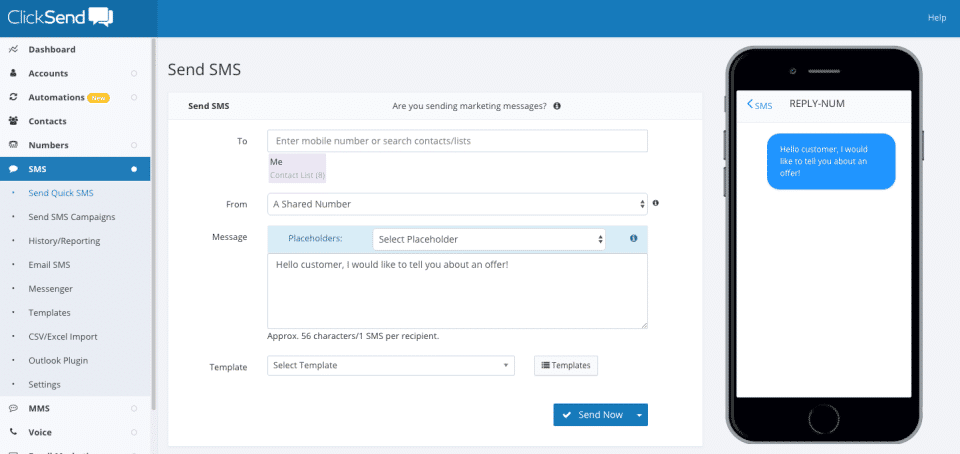
ClickSend does one job and does it without drama: it gets messages delivered. In our testing, setup to first bulk send took under 30 minutes, including importing a list of more than 1,000 contacts.
Delivery from the shared number was clean. Every test message arrived, which is more than we can say for several platforms we have run the same test on.
The trade-off is everything around the sending. Reporting is thin, campaign drafts do not save unless you build them as templates, and there is nothing resembling a marketing suite.
Track, Receive, & Send SMS Online Messages Worldwide. Check out ClickSend.
Visit ClickSend
Pros
- Genuinely pay-as-you-go. No startup fee, no subscription and no contract. Credit stays valid as long as you send or top up once every 12 months, so a slow month costs you nothing.
- Unlimited users at no charge. Most competitors include one to three seats and bill for the rest.
- Inbound messages are free on every number type, so two-way conversations do not double your cost.
- Cheapest per message at small and mid volumes once you top up $100 or more at a time.
- Simple enough to learn in an afternoon. Uploading contacts and building a bulk send took us under 30 minutes from signup, though US delivery still waits on number registration.
- Delivery was reliable in our testing, with no silent failures from the shared number.
- Six API options (REST, HTTP, SMPP, SMTP, FTP, SOAP) plus prebuilt Zapier workflows.
- More than SMS. Voice, email, fax and physical mail run off the same balance, which is unusual and genuinely useful for operational messaging.
- 24/7 support on every account, not gated behind a higher tier.
- A 14-day free trial across every channel, so you can test SMS, voice, email and post before spending anything beyond a number.
Cons
- Carrier fees are not in the advertised rate. Budget 0.42 cents per SMS on top of every price ClickSend quotes.
- No list-growth tooling at all. No opt-in keywords, no signup forms, no landing pages. You bring your own contacts.
- Reporting is shallow. Sends, bounces and basic engagement, with clumsy exports and no device or OS breakdown.
- Campaigns do not save as drafts unless you create them as templates first, so editing a list mid-build can mean starting over.
- Emoji quietly split messages in two. Since you pay per segment, one emoji can double the cost of a send.
- Message approval can delay time-sensitive campaigns. Approvals are usually quick, but build in a buffer.
- Too simple for heavy custom development. Enterprise teams doing deep programmatic work are often better served by Twilio, and we compare them directly in ClickSend vs Twilio.
- You cannot send to the US on day one. A registered number is mandatory, registration runs 1 to 7 business days, and it fails without documented opt-in proof.
- 10DLC fees are unpublished. ClickSend charges a monthly campaign fee and per-number fee for 10DLC and prints neither, so the cheapest route is only cheap once you have asked.
- Short codes are expensive at over $1,000 a month plus the same again to set up.
Other User Testimonials
Don’t just take my word for it, check out some of these users’ testimonials:
“I like everything about ClickSend. They have lots of features and my favourite is SMS. It’s the only feature for which I joined their platform, but after joining their platform I found lots of other services they provide.” -Bhabishya B., Sales Manager, Capterra review
“SUPER affordable payment options – Plenty of flexibility in terms of set-up, which made it easy to fold ClickSend into a very unusual business model – Interface was smooth and easy to explain during roll-out.” -Mikhail R., Senior Operations Associate, Capterra review
“I love the ease-of-use for this platform. Being a small business, I don’t have time to manage all of the personalized communications in a timely manner. Clicksend saves me about 30 minutes each day!” -Thomas T., Website Developer, Capterra review
ClickSend Alternatives
Are you shopping around for a text message marketing solution?
Compare ClickSend with other providers. Check out our detailed guide and get our recommendation on the best SMS marketing software.
Which alternative fits depends on what ClickSend is missing for you.
- You want list growth and campaign tools: SlickText – Read our review
- You want a polished campaign builder and included seats: SimpleTexting – Read our review
- You want pay-as-you-go with no credit top-ups: Textmagic – Read our review
- You want the cheapest high-volume plan: Mobile Text Alerts – Read our review
- You are building on an API and need depth: Twilio – Read our review
- Other options worth a look: Salesmsg, Heymarket, Textedly and EZ Texting
Before settling on an SMS product, price your actual monthly volume on each one. Headline rates in this category are rarely comparable without doing the arithmetic.
Summary
ClickSend is the right choice if you already have your contacts and want the cheapest reliable way to reach them. Top up $100 or more at a time, budget 0.42 cents a message for carrier fees, and it is very hard to beat below roughly 28,000 messages a month.
Pick something else if you need to build a subscriber list, run drip campaigns, or report on them in any depth. Those gaps are deliberate, and no amount of credit closes them.
If your list is ready, start the registration now rather than the week you want to send. The 14-day trial covers every channel, and the number you need to test a US send costs $3.58.
Start Your ClickSend Free Trial
Frequently Asked Questions
How much does ClickSend cost per text?
US SMS starts at 2.93 cents a message on a $20 credit top-up and falls to 0.96 cents on top-ups of $2,000 or more. A carrier fee of 0.42 cents per message applies on top of every one of those rates, so the real entry cost is 3.35 cents.
Does ClickSend have a monthly fee?
No. There is no subscription, no startup fee and no contract. The only recurring charge is for a phone number, at $3.58 a month for a toll-free number. Everything else is prepaid credit that you spend as you send.
Does ClickSend charge extra carrier fees?
Yes. ClickSend passes through US carrier fees at a flat average rate of 0.42 cents per SMS and 0.88 cents per MMS. These apply to toll-free numbers, 10DLC and short codes, and they are not included in any advertised per-message price.
Is ClickSend owned by Sinch?
Yes. ClickSend was founded in 2013 by Matt Larner, acquired by MessageMedia in 2019, and joined the Sinch Group in 2022. Sinch also owns SimpleTexting, so the two platforms share a parent company.
Does ClickSend have a free trial?
Yes, a 14-day trial covering SMS, MMS, voice, email, fax and post. Trial credits expire when the trial ends. One catch matters for US businesses: sending to a US or Canadian number requires a dedicated number even during the trial, so testing a US send costs $3.58 for the month rather than nothing.
How long does it take to start sending with ClickSend?
The account itself is ready in minutes, but reaching US recipients takes longer. A toll-free number has to be registered first, which runs 1 to 7 business days and requires documented proof that your contacts opted in. Registrations without that proof are rejected, so allow a week between signing up and your first US campaign.
What is ClickSend used for?
Businesses use ClickSend to send SMS, MMS, voice calls, email, fax and physical mail from one account. Typical uses are appointment reminders, delivery and order updates, one-time passcodes, internal staff alerts and bulk promotional texts.
Can multiple users share the same ClickSend account?
Yes, and it costs nothing extra. ClickSend includes unlimited users and lets the account owner create subaccounts with their own permissions, which is unusual in a category where most competitors bill per seat.
Is there a character limit in each message that I send?
A standard SMS holds 160 characters, and a Unicode SMS holds 70. Text-to-speech messages allow 300 standard characters or 150 Unicode. Going over splits the message into multiple segments, and you are billed for each one. A single emoji switches the whole message to Unicode, which is the most common way people accidentally double their costs.
Has ClickSend raised its prices?
Slightly, and it changed the discount rules at the same time. In November 2025 ClickSend’s US page charged 2.78c under 5,000 messages sent, 1.98c from 5,000, 1.29c from 50,000 and 0.95c from 150,000. Today the entry rate is 2.93c and the discounts are set by your top-up size instead: $100 of credit buys 2.08c and $2,000 buys 0.96c, however much you actually send. Anything still quoting the old “under 5k” table is describing a retired rate card.
Is ClickSend cheaper than SimpleTexting?
At most volumes, yes. At 5,000 messages a month ClickSend costs roughly $129 all in, against $229 for SimpleTexting’s nearest tier. SimpleTexting includes three seats, opt-in keywords and a campaign builder, so the higher price buys tooling rather than messages.
What payment options can I use?
Credit card and bank transfer are both supported, on either prepaid or postpaid billing. The minimum top-up is $20 by credit card and $200 by bank transfer, so card is the practical choice for smaller senders. Other arrangements can be discussed with their sales team.
Is ClickSend safe to use?
ClickSend is an established provider operating under the Sinch Group, and publishes its security documentation and service status openly. As with any messaging platform, your own compliance obligations still apply, so read our guide to text message marketing laws before you send.